
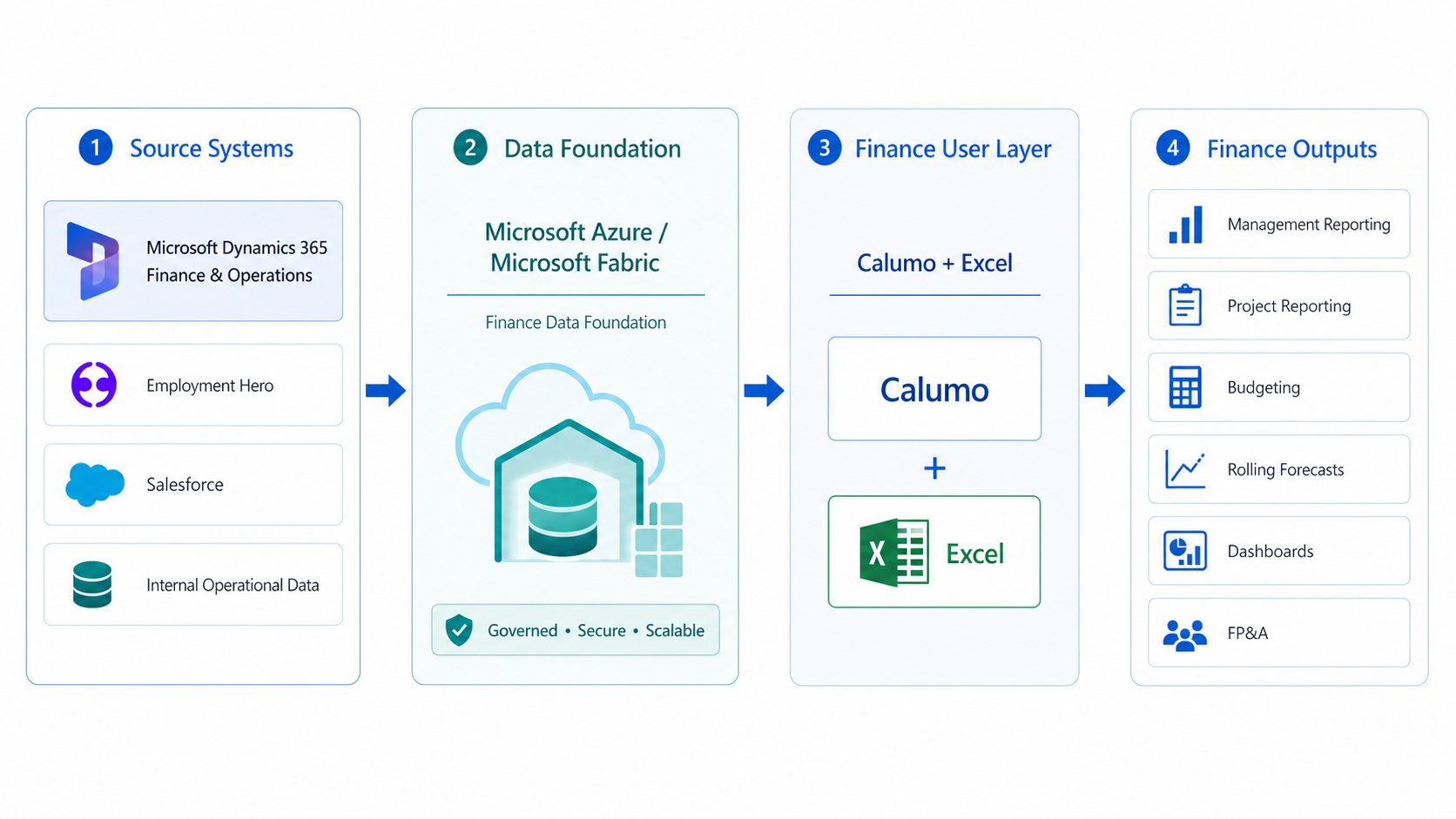
Brydens BI helps Microsoft Dynamics 365 finance teams extend their ERP environment with Calumo for stronger management reporting, project reporting, budgeting, rolling forecasting, dashboards and FP&A.
We take an active, hands-on role in every engagement. Rather than simply integrating systems and expecting finance teams to work through the data themselves, we collaborate with CFOs, finance leaders and reporting teams to create Calumo solutions that are practical, well-supported and tailored to the business’s real reporting, planning and decision-making processes.
Brydens BI has delivered Calumo solutions for organisations using Microsoft Dynamics 365, including Standards Australia and Geocon. These projects show how D365 data can be extended into a broader finance performance management environment covering reporting, planning, forecasting and analytics.
For many businesses, D365 Finance & Operations sits at the centre of ERP and transactional processing. Calumo complements this by surrounding D365 with a controlled reporting and planning framework, allowing finance teams to integrate financial, project, workforce, operational, budgeting, forecast and executive reporting data into one consistent environment. It helps that Calumo is also Microsoft-centric
Why D365 Finance Teams Look Beyond ERP Reporting
Microsoft Dynamics 365 Finance & Operations provides strong ERP capability across finance, projects, procurement, operations and enterprise processes. For many finance teams, however, the next stage of maturity is not simply more transactional reporting. It is better visibility, better planning and better decision support.
As organisations grow, finance teams often need faster management reporting, board and executive packs, project-level budgeting, rolling forecasts, scenario modelling, dashboards, workforce and employee cost allocation, and more controlled Excel-enabled processes that finance users can trust.
They also need confidence that the numbers reconcile, the mappings are controlled, and the reporting logic is repeatable from month to month.
That is difficult to sustain when key reporting and planning processes depend on disconnected spreadsheets, manual exports and one-off adjustments.
Calumo helps by giving D365 finance teams a structured performance management layer. It allows finance users to keep working in familiar Excel-based reporting and planning environments where appropriate, while improving governance, consistency and control over the underlying data.
Practical Calumo and Microsoft Dynamics 365 Experience
Brydens BI has hands-on experience delivering Calumo solutions for organisations using Microsoft Dynamics 365. These projects often extend beyond the general ledger, combining D365 with HR, CRM, project, data warehouse or operational systems to create a more complete finance reporting and planning environment.
Standards Australia: D365, Employment Hero and Rolling Forecasting
Standards Australia implemented Calumo to modernise and streamline its management reporting framework, introduce rolling forecasting, and support detailed project-level budgeting with integrated employee cost allocation.
The solution was initially connected to Microsoft GP. It has since been upgraded to integrate via API with D365 Finance & Operations, Employment Hero and the organisation’s internal data warehouse with information flowing in both directions.
This strengthened automation, data accuracy and financial oversight while preserving the broader Calumo planning and reporting environment. For finance teams moving from legacy finance systems into D365, this is an important point. A well-designed Calumo environment can adapt as underlying systems change.
Geocon: D365, Salesforce and Employment Hero
Geocon has used Calumo and been supported by Brydens BI for many years.
Information from Dynamics F&O general ledger and projects, along with Salesforce and Employment Hero, is automatically populated into Geocon’s Calumo Data Warehouse on both periodic and on-demand refresh cycles.
Calumo is used across management reporting, dashboarding, budgeting and rolling forecasts. As Geocon’s underlying systems have changed over time, Calumo has adapted, continuing to provide a stable finance reporting and planning layer around the organisation’s data.
These examples show that the value is not just connecting D365 to Calumo. The real value comes from building a governed finance layer that combines D365 with the other systems finance teams need to understand performance properly. Being able to generate reports and dashboards or undertake adhoc analysis that effortlessly uses data from the General Leger, Projects Module, Salesforce, and HR unlocks significant value.
What a Calumo and D365 Solution Can Deliver
A successful Calumo and Microsoft Dynamics 365 solution is not just a technical integration. The value comes from designing the finance model properly.
Brydens BI works with finance teams to understand the reporting structures, planning cycles, project reporting requirements, consolidation needs, business rules and management outputs that matter. From there, we build a solution that can support day-to-day finance operations and continue to improve over time.
Depending on the client, this may include:
- D365 integration into Calumo and a governed Finance Data Warehouse
- General ledger, transaction-level, project and job-level reporting
- Board, executive and monthly finance reporting packs
- Budgeting, rolling forecasting and scenario modelling
- Workforce, employee cost allocation and project planning support
- HR, CRM, operational or internal data warehouse integration
- Excel-enabled reporting and planning with stronger governance
- Ongoing support, enhancement and finance-team enablement
The aim is not to replace D365. Microsoft Dynamics 365 remains the ERP and transactional system of record. Calumo provides the finance-owned layer for reporting, planning, forecasting and FP&A.
From D365 Reporting to Broader FP&A
Many D365 clients begin with a reporting problem.
Month-end reporting takes too long. Project reporting is difficult to maintain. Forecasting is disconnected from actuals. Board reporting depends on spreadsheets that are hard to control. Different teams may have different versions of the numbers.
Once D365 data is connected into a governed Calumo model, finance teams can start to address those issues in a more structured way.
Actuals, budgets, forecasts, mappings, hierarchies and reporting logic can be brought together into one environment. That creates a stronger foundation for monthly management reporting, board reporting, project-level reporting, annual budgeting, driver-based rolling forecasts, scenario analysis, workforce planning, cost allocation, dashboarding and operational KPI analysis.
The real benefit is not simply faster reports. It is a better finance operating model. Finance teams spend less time assembling numbers and more time explaining performance, testing assumptions and supporting better business decisions.
Combining D365 with Other Business Systems
One of the strongest use cases for Calumo is bringing D365 data together with other business systems.
In many organisations, D365 is not the only system finance teams care about. HR, payroll, CRM, project, operational and data warehouse sources often contain information needed for reporting and planning.
Brydens BI has delivered Calumo environments that combine D365 data with information from systems such as Employment Hero, Salesforce and internal data warehouses. This gives finance teams a broader reporting view across the business, rather than being limited to the ERP alone. Where appropriate, finance-approved data from Calumo can also be written back to the internal data warehouse, supporting a controlled flow of information between finance and the wider data environment.
Rather than forcing all analysis to happen directly inside the ERP, Brydens BI designs a finance-ready data foundation that can combine D365 with the other datasets finance needs. Calumo then sits on top of that foundation to support reporting, consolidation, budgeting, forecasting and analysis.
This gives finance a single, governed environment for decision support while still allowing operational systems to do what they do best.
Why the Data Model Matters
One of the most important parts of any D365 and Calumo project is the data model.
A connector can move data from D365 into another environment, but it does not automatically create useful management reporting, forecasting or decision support. Finance teams need the data structured around how the business is actually managed.
That can include entity structures, management account mappings, project and job views, workforce cost allocation, reporting hierarchies, forecast versions, scenario assumptions, internal data warehouse inputs and controlled manual adjustments.
Brydens BI focuses on this design work because it is where many reporting and planning projects succeed or fail. A good Calumo model should be technically reliable, but also practical for finance users to maintain, review and explain.
Supporting D365 Clients Over Time
Finance reporting and planning requirements rarely stay still.
A business may add entities, change reporting structures, introduce new project or job reporting, acquire another business, refine its forecast process or add new systems such as HR, CRM, operational or project platforms.
For that reason, Brydens BI places significant emphasis on ongoing relationships. We often continue working with finance teams after the initial implementation to support month-end reporting, improve existing models, add new reporting views, refine forecasting logic, extend dashboards and help internal users become more self-sufficient.
This ongoing relationship is important because Calumo is most valuable when it evolves with the finance function. The first release may solve the immediate reporting or planning problem, but the platform can then be extended into broader analytics, forecasting and FP&A capability.
Calumo for D365 During System Change
Calumo can be especially useful during periods of finance systems change.
When an organisation moves from a legacy system into D365, the ERP implementation is usually only one part of the finance transformation. Management reporting, project reporting, budgets, rolling forecasts and executive packs still need to keep operating during and after the transition.
A Calumo layer can help preserve continuity by separating core reporting and planning logic from the source ERP. As long as the data is mapped and governed properly, finance teams can maintain familiar reporting outputs while the underlying system landscape changes.
This was an important part of the Standards Australia story. Calumo was initially connected to Microsoft GP and later upgraded to integrate with D365 Finance & Operations, Employment Hero and the organisation’s internal data warehouse, while preserving the broader planning and reporting environment.
For growing and changing organisations, this flexibility can be valuable. It allows finance teams to modernise systems without losing control of the reporting and planning processes that senior management relies on.
Greenfield Calumo and D365 Projects
For organisations starting fresh with Microsoft Dynamics 365 and Calumo, Brydens BI would typically begin with the highest-value finance outcomes.
That often means connecting D365 financial and project data into Calumo, validating actuals, building core reporting hierarchies, designing project or employee cost allocation logic, creating management reports and establishing the first budgeting or rolling forecast model.
From there, the solution can be expanded into dashboards, operational reporting, workforce planning, project-level analysis, cash flow forecasting, scenario modelling and broader FP&A.
A practical implementation should balance speed and governance. Finance teams need useful outputs quickly, but the underlying design must be robust enough to support future growth.
Why Brydens BI Is a Strong Fit for D365 Finance Teams
Brydens BI combines hands-on Calumo delivery experience with finance-led data architecture and practical CFO-level understanding.
That combination matters. A successful D365 and Calumo project requires more than technical integration. It requires a clear understanding of finance processes, reporting cycles, planning requirements, project reporting, governance, controls and the way finance teams actually work.
Our work is hands-on and relationship-led. We help clients design the model, build the solution, validate the outputs, train finance users and continue improving the environment after go-live.
For D365 clients, Brydens BI brings:
- Practical Calumo implementation experience
- Experience integrating Calumo with D365 Finance & Operations
- Finance Data Warehouse design on Microsoft Azure
- Management reporting and FP&A capability
- Budgeting, forecasting and scenario modelling experience
- Multi-system finance integration experience
- Ongoing support beyond the initial implementation
The result is a Calumo solution that is not just technically connected to D365, but genuinely useful to the finance team.
Learn more about our approach to Calumo implementation and support.
Related Calumo and ERP Reporting Solutions
Brydens BI also supports reporting, budgeting, forecasting, dashboards, process automation and FP&A solutions across other finance systems, operational platforms and data sources.
Common Microsoft Dynamics 365 and Calumo Questions
Can Calumo integrate with Microsoft Dynamics 365 Finance & Operations?
Yes. Brydens BI has delivered Calumo solutions that integrate with D365 Finance & Operations, including API-based integration patterns for finance and related data.
Why use Calumo if we already have D365?
D365 remains the ERP and transactional system of record. Calumo provides an extended reporting, planning, forecasting, dashboarding and FP&A layer around it. This is especially useful when finance needs more flexible reporting, scenario modelling, Excel interaction, workflow, or integration with non-financial systems.
Can Calumo support budgeting and forecasting around D365?
Yes. Once D365 data is available in a governed finance data foundation, Calumo can support budgeting, rolling forecasts, scenario modelling, workflow governance and broader FP&A capability.
Can Calumo combine D365 with other systems?
Yes. Many finance reporting requirements require more than ERP data. Calumo can combine D365 with payroll, HR, CRM, project, operational and data warehouse sources to support integrated reporting and planning.
Can Calumo support project-level reporting and budgeting?
Yes. D365 project data can be combined with finance, workforce and operational data to support more detailed project reporting, employee cost allocation, budget monitoring and rolling forecasts.
Can we keep using Excel?
Yes. Calumo supports Excel-enabled reporting and analysis while maintaining a governed central data model. This gives finance users flexibility without returning to disconnected spreadsheet processes.
Does Calumo replace D365?
No. D365 remains the transactional system of record. Calumo extends D365 by providing a finance performance management layer for reporting, planning, forecasting, dashboards and governed Excel-enabled analysis.
Is this only relevant for large organisations?
No. The value depends less on size and more on finance complexity. Organisations with project reporting, multiple systems, rolling forecasts, board reporting, employee cost allocation or complex management reporting can benefit from a governed Calumo layer around D365.
A Practical Next Step for D365 Finance Teams
For D365 finance teams looking to improve management reporting, project reporting, budgeting, rolling forecasting or broader FP&A capability, Brydens BI can help design and support a practical Calumo solution around your Microsoft Dynamics 365 environment.
Because Brydens BI has delivered Calumo solutions for D365 clients such as Standards Australia and Geocon, future clients can benefit from a more informed starting point, proven hands-on experience and an ongoing relationship focused on continuous improvement.