
The finance data warehouse is where AI for finance either succeeds or fails
AI in finance is getting a lot of attention, and understandably so. There are obvious opportunities to speed up commentary, summarise results, support forecasting, review board packs and help finance teams work through large volumes of data more quickly.
But in practice, the first question is not usually “Which AI model should we use?”
The better question is: can the AI trust the finance data it is being asked to interpret?
That is where many AI initiatives in finance will either succeed or fail. Not because AI cannot write a useful paragraph, identify a trend or summarise a result. It often can. The issue is whether the numbers, structures and definitions underneath the answer are governed, reconciled and finance-ready.
In finance, a confident answer is not enough. The answer needs to reconcile. It needs to be explainable. It needs to be traceable back to the source. It needs to stand up to review by the CFO, the board, auditors or business unit leaders.
That does not start with AI. It starts with the finance data layer.
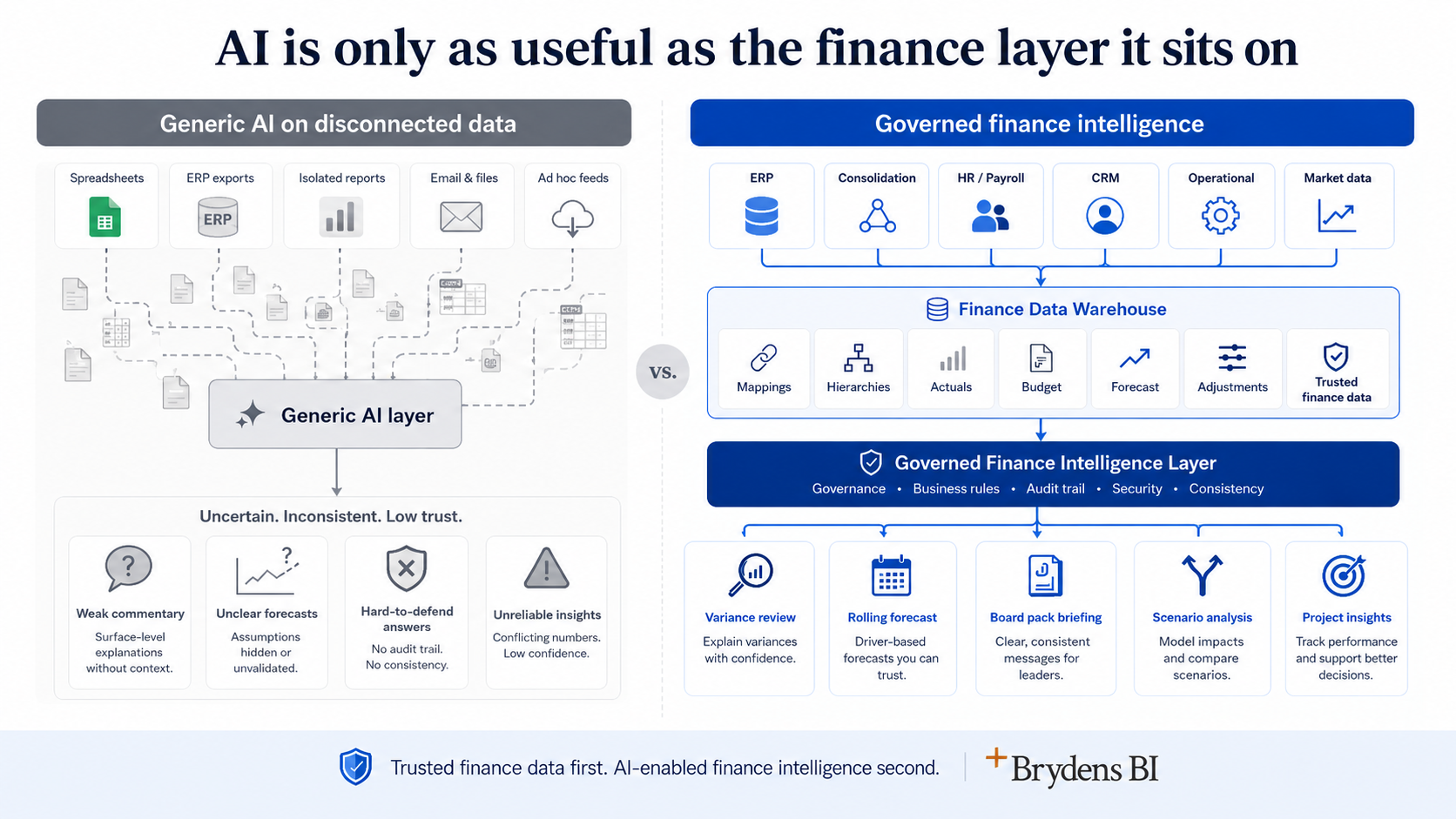
At Brydens BI, we often see finance teams that already have access to plenty of data. The data is in the ERP, payroll system, project system, CRM, operational systems, spreadsheets and reporting tools. The issue is not that the data does not exist. The issue is that it has not yet been shaped into the form finance needs for reporting, planning, forecasting and decision-making.
Raw ERP data is not the same as finance-ready information.
The ERP may know the transaction. Finance needs to know how that transaction should appear in the management report, the board pack, the forecast and the consolidation. That usually requires a finance-owned layer that understands reporting accounts, business units, departments, projects, entities, scenarios, hierarchies, eliminations, reclasses and approved definitions.
This is why the finance data warehouse, set up for Finance, becomes so important.
A well-designed finance data warehouse creates a trusted layer between source systems and finance decision-making.
It does not replace the ERP. It does not replace Excel. It does not replace the finance team. Its role is to bring the key finance data together, apply the right structures and make that data useful for reporting, planning, analysis and performance management.
For many Brydens BI clients, the hard work is done and this type of foundation already sits in SQL. Actuals, budgets, forecasts, prior-year data, mappings, reporting hierarchies, adjustments and source-system detail can all sit in a governed finance model. That model then becomes the layer that finance trusts.
AI should sit adjacent to that layer, not around it.
That is an important distinction. If AI is connected directly to disconnected spreadsheets, raw extracts and inconsistent reports, it may still generate a useful-sounding answer. But the finance team may not be able to reconcile or defend it. If AI is connected to a trusted finance data layer, the answer has a much better chance of being useful, controlled, explainable and repeatable.
This is particularly important because AI commentary is only one use case.
Variance commentary is a logical starting point because it is time-consuming and often repetitive. But the broader opportunity is not just to draft commentary faster. The broader opportunity is to help finance teams review commentary, challenge and even discuss weak explanations, prepare board pack summaries, compare actuals to budget and forecast, identify unusual movements, explain scenario changes, support forecast reviews and retain knowledge from one reporting cycle to the next.
Those are not just writing tasks. They are finance tasks, and finance tasks need finance context.
A revenue variance, for example, is rarely just a revenue variance.
It might be volume, price, mix, timing, seasonality, a one-off fee, a new contract, a reclassification or a budget phasing issue. A cost increase might be a problem, or it might also be expected project activity, planned recruitment, a delayed invoice, an accrual correction or a change in allocation logic.
A generic AI assistant does not automatically know which explanation is likely. It needs the surrounding finance model. It needs to understand the accounts, entities, departments, scenarios, reporting structures and prior explanations. It needs to know what the business usually considers material, which version of the forecast is current and whether a movement is consistent with previous months.
That is where the idea of a business-specific finance brain becomes useful.
The phrase can sound a bit futuristic, but the practical idea is straightforward. Over time, a trusted finance data warehouse can support a governed finance intelligence layer that understands how a particular organisation reports, plans and explains performance.
It is not just a chatbot pointed at finance data. It is a controlled layer that builds on the finance model, the reporting structures, the approved definitions, the commentary history and the known business context. It understands that certain costs are seasonal, that some revenue lines are project-driven, that particular entities behave differently, that certain adjustments recur each month and that some explanations have already been reviewed and accepted by finance leadership.
In practice, finance does not start from a blank page every month. The same reporting packs are produced. The same types of variances appear. The same questions come back in different forms. The same business drivers need to be explained again and again.
A business-specific finance brain helps retain and reuse that knowledge. It can give finance a better starting point, while still leaving the judgement, approval and interpretation with the finance team.
A construction or project-based business is a good example.
For that type of business, AI should not only be used to explain last month’s project variance. There may be a much more valuable use case in learning from completed jobs and applying that experience to current and future jobs.
A construction business builds up years of project history. Each completed job has its own characteristics: project type, location, contract value, duration, client type, labour profile, subcontractor mix, variations, delays, claims, cost profile, revenue profile and final margin outcome. If that history is held in a governed finance data layer, it becomes a valuable reference base.
At Brydens BI, across several clients, we have adapted machine learning to compare current or proposed jobs with similar completed jobs. It helps identify whether costs are emerging earlier than expected, whether revenue recognition is tracking differently, whether labour usage is outside the normal pattern or whether subcontractor costs are behaving differently from similar projects in the past.
The point is not that the model replaces the project manager or the finance team. It does not. The value is that it can provide an earlier signal.
Instead of waiting until a job is clearly off track, finance and operations can see that a project is not behaving like similar completed projects. That may highlight a negative risk, such as margin deterioration or cost overrun. It may also highlight positive outperformance that should be understood and potentially repeated elsewhere.
That is a much more practical example of one potential benefit of business-specific finance brain. The business is not just reporting history. It is using its own history to improve current and future decisions.
This is the same principle that applies to board packs, forecasts, management reports and variance analysis.
The AI layer becomes more useful when it is working from trusted data and business-specific context along with a history of known decisions and preferences. It can help summarise, challenge, compare and explain, but it needs a governed foundation underneath it.
There is also a control point here that should not be understated.
The risk with AI in finance is not that it gives no answer. The risk is that it gives an answer that sounds reasonable but cannot be reconciled, traced or defended. That may be acceptable in a general research task. It is not acceptable in a finance process.
Finance needs to know where the number came from, which scenario it relates to, which hierarchy was used, whether adjustments are included and whether the explanation is supported by the underlying data. If the answer cannot be tied back to the finance model, it will be difficult to trust.
This is why AI should extend the finance process, not bypass it.
Finance should still own the definitions, mappings, reporting structures, scenarios, approvals, materiality thresholds and business interpretation. AI can then help with review, summarisation, investigation, scenario comparison, evidence gathering, forecast explanation and knowledge reuse.
That is a much safer and more useful model.
Before asking which AI tool to use, CFOs and finance teams should ask whether they have a trusted finance data layer that AI can safely interpret. Once that layer exists, the opportunity becomes much larger than faster commentary. It becomes possible to build a governed finance intelligence layer that understands how the organisation reports, plans, forecasts and manages performance.
AI for finance will not be won by connecting a model to the most data. It will be won by connecting AI to the right data: governed, reconciled, structured and finance-ready. That is how finance teams move beyond one-off AI outputs and start building something more durable. A business-specific finance brain that reflects the way the organisation actually works.
And that is why the finance data warehouse is where AI for finance either succeeds or fails.