
One trusted foundation for reporting, planning and AI.
Bring financial and operational data together with the rules, structures and controls your business needs. Brydens BI designs, builds and supports finance data warehouses that make reporting more reliable, planning more connected and automation easier.
When getting the numbers together becomes the hard part.
Your systems hold the data, but Finance still spends too much time turning it into something the business can use.
Different systems. Different answers.
Entities, departments and systems use different account structures, definitions and reporting rules.
Reporting rebuilt every month.
Extracts, spreadsheet lookups and manual adjustments stand between closing the ledger and reviewing performance.
Consolidation becoming a bottleneck.
Acquisitions and multiple ledgers add complexity, with more reconciliations and more opportunities for error.
Plans disconnected from actuals.
Budgets and forecasts sit in separate workbooks, making comparisons and updates harder than they should be.
Business rules held by individuals.
Important mappings, allocations and calculations depend on someone remembering how the process works.
AI needs more context.
Useful analysis requires the right figures, reporting structures, forecast versions and business information.
What is a finance data warehouse?
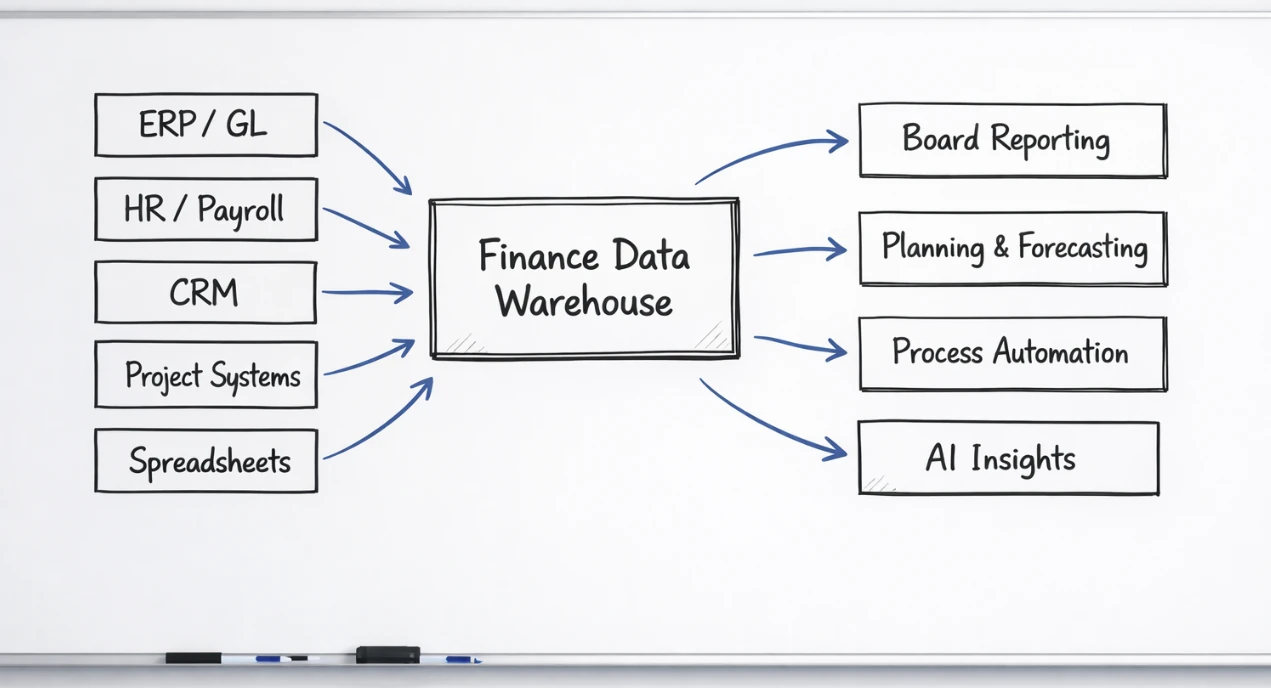
A finance data warehouse brings data from your business systems into a structured environment designed for financial reporting, consolidation, planning and analysis.
It combines the underlying transactions with the account mappings, reporting hierarchies, business rules and controls needed to produce consistent results. Finance can move from the group position to an entity, project or transaction without rebuilding the numbers in separate spreadsheets.
Brydens BI works with Finance and IT to design that foundation around your business. It can draw from existing data platforms, connect directly to source systems, or combine both approaches.
Connected at the source. Consistent across the business.
- ERP and general ledger
- Payroll and people
- Projects and property
- CRM and sales
- Operational systems
- Existing data platforms
- Integrated financial and operational data
- Agreed definitions and reporting hierarchies
- Mappings, calculations and finance rules
- Actuals, budgets, forecasts and scenarios
- Reconciliation, controls and traceability
- Reporting
- Analytics
- Planning
- Automation
- AI and agents
The same governed data supports management reports, dashboards, forecasts and automated processes. AI can use that foundation alongside relevant business context, with access and review controls appropriate to the task.
Built around how Finance actually works.
Your reporting structures
Bring different charts of accounts and entity structures into agreed management and statutory reporting views.
Consolidation and adjustments
Support intercompany eliminations, currency translation, allocations and adjustments, with clear rules and review processes.
Connected planning
Bring actuals, budgets and forecast versions together to support variance analysis, rolling forecasts and scenario modelling.
Figures you can investigate
Trace results through reporting hierarchies to supporting transactions and source references.
Controlled automation
Automate recurring calculations, data refreshes and workflows. Where required, approved outputs can be passed back to source systems.
Context for AI
Give AI access to agreed measures, reporting structures and relevant business information so it can assist with investigation, commentary and follow-up questions.
Changing your ERP? Make the reporting work better too.
An ERP implementation, acquisition or major system change is a good time to review the reporting and planning processes around it.
Brydens BI helps teams decide which reports, calculations and workflows to retain, improve or automate. A shared finance data warehouse can bring historical and current data together, helping preserve reporting continuity as underlying systems change.
We work with systems including Microsoft Dynamics 365, NetSuite, Sage Intacct, Xero, Jobpac, Vista and other finance and operational applications. Connections, data availability and scope are confirmed during discovery.
Work with the technology that fits your business.
We use proven Microsoft data technology and specialist finance tools to build solutions around your reporting, planning and governance needs.
Depending on the scope, this can include Azure SQL, SQL Server, Azure Data Factory and integration with existing enterprise data platforms. Finance CoreIQ, Calumo, Power BI and Excel can provide complementary ways to access and use the data.
If your organisation already has a data warehouse or data lake, we work with your Data and IT teams to establish how Finance’s requirements should fit into it.
Finance experience, from design through to ongoing support.
We speak Finance.
Our finance backgrounds help us work directly with your team to understand the reporting, planning and control requirements behind the data.
We turn discussions into working solutions.
We help define the approach, build practical examples and refine the solution with your team.
We understand the wider business.
Our work connects finance with people, projects, customers and operations so reporting reflects how the business performs.
We stay involved.
The team that understands your solution continues to support and improve it as your business changes.
Explore the foundation in more detail.
What a Finance Data Warehouse Should Actually Contain: A CFO’s Practical Architecture Guide
A practical guide to the data, rules and structures behind trusted reporting and planning.
Read article →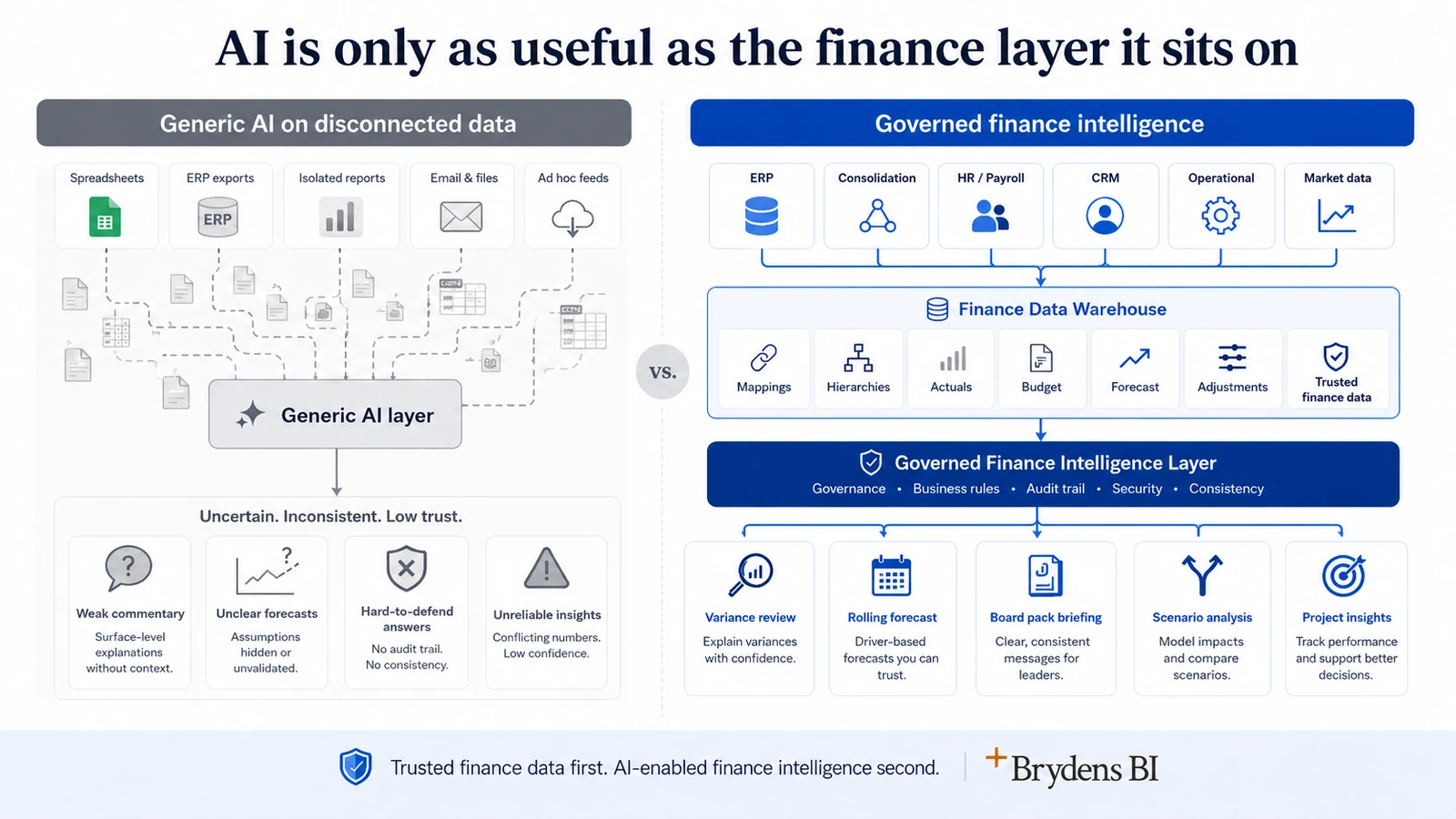
The finance data warehouse is where AI for finance either succeeds or fails
Why useful AI depends on trusted finance data, consistent definitions and clear business rules.
Read article →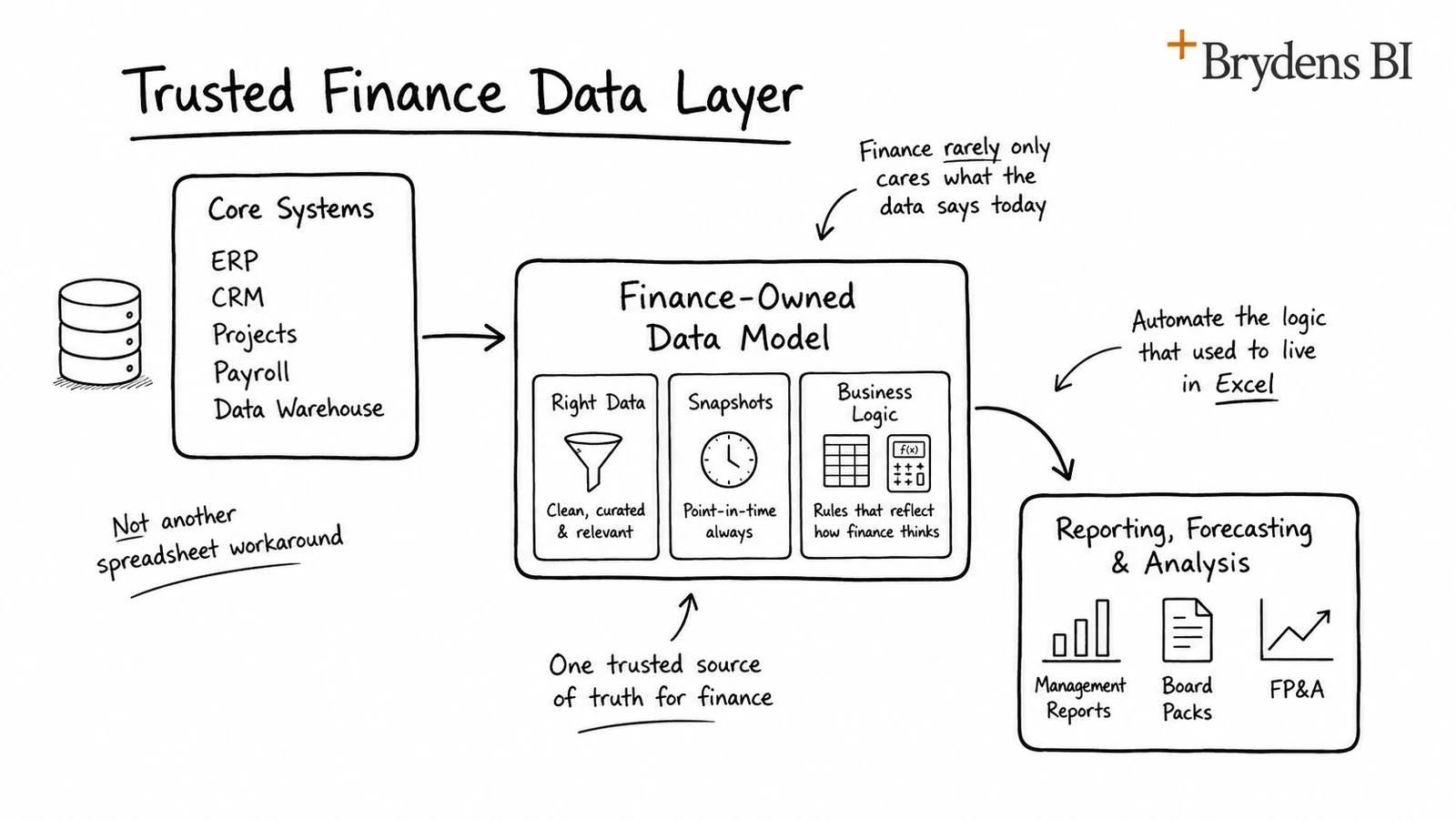
From ERP Data to Board Reporting: Why Finance Needs Its Own Trusted Data Layer
Connect source systems into a trusted foundation for reporting, forecasting and analysis.
Read article →Questions finance teams ask
Usually, the finance data warehouse works with your existing ERP and other business systems. We assess what can be connected and where the reporting or process gaps sit.
Yes. We can work with your existing data environment and internal team to define and implement the structures, rules and controls Finance needs.
Yes. Excel can remain part of reporting and planning, connected to governed data. The approach depends on your chosen tools and requirements.
Yes. Bringing different systems, account structures and entity reporting requirements together is a common use case. The mappings and consolidation requirements are agreed during design.
It gives AI a more consistent foundation of financial data, definitions and reporting rules. Relevant business context, permissions and review controls are also needed for useful results.
Yes. We can scope an initial priority and build a foundation that accommodates further reporting, planning or automation requirements over time.
Bring us the reporting challenge.
Whether you are bringing multiple systems together, replacing spreadsheet processes or preparing your finance data for AI, we can help you work out where to start.