
In today’s finance environment, owning a dedicated finance data warehouse is increasingly important. It provides a governed foundation for actuals, budgets, forecasts, commentary, and operational data structured around finance needs. Establishing that foundation can be complex and often takes weeks, particularly where internal IT teams have limited finance-specific experience. With Calumo and specialist implementation support, finance teams can implement that foundation more efficiently and use it for reporting, planning, analysis, automation, and future AI initiatives.
Understanding the Finance Data Warehouse:
At its core, a Finance Data Warehouse serves as the nerve centre of financial data management. It acts as a centralised repository, aggregating financial data from various sources, including General Ledger systems, budgeting and forecasting tools, operational databases, relevant external sources, and manual input and commentary. By consolidating data at a granular level, the Finance Data Warehouse enhances the contextual understanding of financial information, facilitating automation, comprehensive reporting and analysis.
The Role of Calumo in the Finance Data Warehouse:
Calumo is the primary finance platform; Power BI is an optional complementary visualisation layer.
Calumo transcends traditional reporting and budgeting tools by offering a comprehensive solution that includes creating a tailored Finance Data Warehouse in Microsoft SQL Server using a dimensional model approach. This Finance Data Warehouse is then expanded over time to further empower finance.
Calumo uses cubes that can be viewed and queried online for fast, self-service analysis, while data can also be accessed directly from the Finance Data Warehouse where required. This gives finance teams flexibility in how they report and analyse information, with reports authored in Excel so users can work in a familiar environment. Calumo also supports writeback, commentary capture, and a range of finance-specific modelling and automation needs, including allocation journals, commission calculations, eliminations, and other controlled processes.
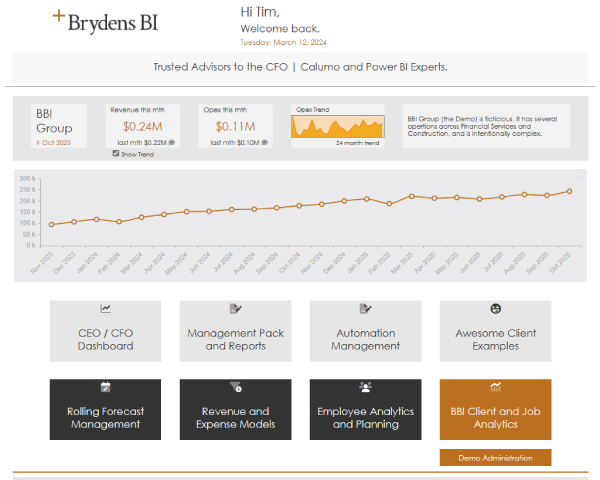
Calumo includes charting capabilities and can leverage Excel charts, while Power BI can serve as a complementary visualisation layer when more specialised dashboards are needed. Tailored, updatable datasets can be delivered to Power BI directly from the finance data warehouse, making it easier to build targeted dashboards while maintaining a single source of truth. This reduces data wrangling and avoids unnecessary DAX complexity for finance teams.
Challenges in Establishing a Finance Data Warehouse:
Establishing and maintaining a finance-centric data warehouse poses unique challenges, especially for IT teams who may not be deeply familiar with the specific needs and nuances of the finance domain, may have limited or no prior experience in developing and managing finance-specific data warehouses, and, like any good IT team, may have many competing priorities.
This knowledge gap underscores the importance of partnering with a specialised consultancy like Brydens BI. With a wealth of experience in developing and managing complex Finance Data Warehouses, Brydens BI is a trusted ally, leading and guiding organisations through every implementation stage, always being available and providing ongoing support as an extension of the Finance team.
A good Finance Data Warehouse is data source agnostic. Over several years, Brydens BI has had many clients change source systems, staff, buy and sell businesses, and work through reorganisations. The only constant is the Finance Data Warehouse, with Calumo as its key interface. Several finance leaders have made implementing Calumo an early priority after joining a new business because they are accustomed to working with timely, reliable finance information rather than navigating an Excel quagmire or tools not specifically designed for finance.
How Calumo works with Power BI and Excel
Calumo’s Finance Data Warehouse and finance-friendly reporting and modelling provide the foundation. Power BI can then add visualisation and ad hoc analytical capability where required, while Excel remains familiar for report authoring and day-to-day finance use. With Brydens BI’s implementation experience and support, organisations can get up and running more quickly and make more effective use of these tools for reporting, analysis, and decision-making.
Frequently Asked Questions:
How does Calumo differentiate itself from traditional budgeting tools?
Calumo goes beyond traditional budgeting tools by providing a broader finance platform built on a tailored finance data warehouse. Rather than focusing only on budget input, it supports reporting, planning, analysis, commentary, and writeback in a governed finance environment.
Because Calumo links directly to a finance data warehouse built on Microsoft SQL Server using a dimensional model approach, it gives finance teams a stronger foundation for working with actuals, budgets, forecasts, and relevant operational data in one place. Reports are authored in Excel, allowing users to build on familiar skills while working from governed, well-structured datasets.
This foundation also helps finance teams become more AI-ready by creating cleaner, more consistent, and better-governed data for future automation, modelling, and AI initiatives. Where Power BI is used, tailored datasets can also be provided from the finance data warehouse, making it easier to build dashboards without placing unnecessary data wrangling or transformation effort on finance teams.
What specific advantages does linking Power BI with Calumo offer finance teams?
Many staff will have experience with Excel and Power BI. Linking Power BI with tailored datasets from the Finance Data Warehouse that underpins Calumo ensures a single source of truth, removing key data sourcing and data transformation issues associated with Power BI. It also means Finance teams get the best of both worlds, including the enhanced visualisation capabilities of Power BI and the data management, modelling, and finance-friendly reporting capabilities of Calumo.
How does Brydens BI support clients with their Finance Data Warehouse and Finance needs?
Brydens BI offers specialised expertise in designing, implementing, and supporting Finance Data Warehouse and analytics capabilities, drawing from its extensive experience with a range of large private and listed companies. Given its Finance and IT knowledge, combined with its depth of experience, a typical implementation requires only limited input from client-side resources.
Collaborating closely with clients, Brydens BI actively provides options, suggests best practices and delivers tailored solutions that address unique needs and challenges. As client businesses grow and change, Brydens BI remains available to ensure the underlying data warehouse and any associated applications and automation stay current. This allows the Finance team to focus on adding value and driving efficiency, accuracy, and strategic decision-making.