
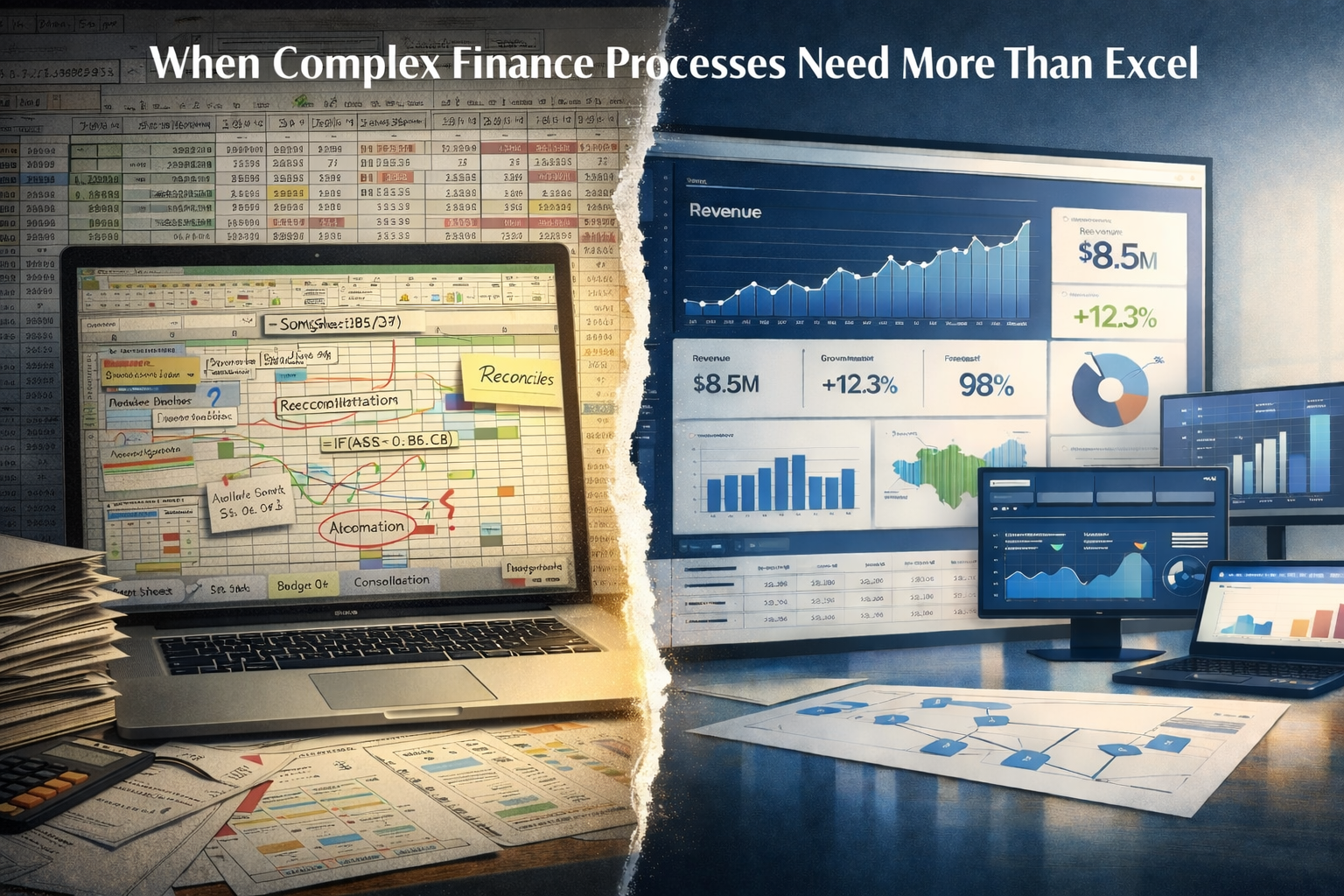
Some finance processes outgrow Excel and need to be moved into proper systems.
They often start in Excel because they need to be defined, but as they grow in complexity and importance, spreadsheets become slower, more fragile, and harder to control.
What begins as a practical model can become difficult to manage as the business grows. Month-end takes too long. Allocations rely on manual handling. Reporting sits across disconnected systems. Critical calculations depend on spreadsheets that are no longer fit for purpose.
That is usually the point where finance teams need more than a better workbook. They need a more scalable system for reporting, planning, and finance process automation, often built around the right data foundation and platforms such as Calumo.
Complex Allocations and Slow Month-End Processes
One of the clearest examples is complex allocations. In some businesses, cost allocations and month-end journals still rely on extensive spreadsheet manipulation. The process can take days, consume senior finance time, and create unnecessary risk. Brydens BI has replaced these spreadsheet-heavy allocation processes with rule-driven allocation logic and automated journal generation, turning a fragile month-end task into a controlled process that runs in minutes rather than days. For a large Superannuation fund client, Brydens BI turned what was a 3-4 day exercise, which dramatically slowed the release of final numbers, into a process that takes under 30 minutes and is always on, enabling users to view fully allocated numbers at any time.
Lack of a Single Source of Truth Across Finance and Operational Data
Another common problem is the lack of a single source of truth across finance and operational data. Financial results may sit in one system, while project data, asset data, payroll information, or other operational drivers sit elsewhere. That makes it difficult for executives to understand what is really driving performance. For a diversified property and infrastructure client, Brydens BI built a finance data warehouse in Microsoft Azure, integrating general ledger data with operational systems and using Calumo for reporting, driver-based modelling, and executive dashboards. The result was a governed environment where leadership could view profitability and performance by project, asset, and business unit instead of trying to piece the picture together from disconnected systems.
Employee Commission Calculations
Commission calculations are another area where spreadsheet strain becomes obvious. These models often require a mix of finance, HR, and operational data, and they become harder to manage as rules grow more detailed and staff numbers grow. One client had employee commissions calculated in Excel using data pulled from the general ledger, HR systems, and internal operational systems. Manageable for 10 staff, problematic at 30, near impossible as staff numbers approached 100. Brydens BI implemented Calumo as the finance and performance layer, linking Sage Intacct, Employment Hero, and the internal operations system into a unified finance data warehouse environment. Commission calculations, even with staff numbers comfortably over 100, are now managed in a controlled, auditable way, with employees given read-only access to their results. The same environment also supports automated reporting and three-way rolling forecasts.
End-to-End Project Knowledge and Predictive Pipeline Visibility
Project-based businesses often face the same problem at a larger scale. Critical data is spread across ERP, CRM, estimating, and other operational systems, making project reporting, estimate benchmarking, and forward planning slower and less reliable than they should be. For one construction client, Brydens BI built a purpose-designed integrated data warehouse that brought together finance, project, CRM, estimating, and operational data into one reporting and modelling environment available to Calumo. This now supports enterprise-wide finance and project reporting, estimate benchmarking, stronger cost modelling for future tenders, reporting across HR, HSEQ, and bank guarantees, and machine learning for forward project pipeline visibility.
Why This Matters
The pattern across these examples is straightforward. As businesses grow, bespoke Excel models often grow with them. They become slower, harder to maintain, and riskier to rely on for critical finance processes. What worked for a smaller or simpler business starts to break down once the organisation needs faster close cycles, more integrated reporting, and better forward visibility.
That is where a more scalable finance platform starts to matter. With the right data foundation and the right reporting and planning layer, finance teams can move away from manual handling and fragmented logic toward a more controlled, transparent, and useful environment. Many of these outcomes can also be seen across Brydens BI’s client examples.
For organisations facing slow month-ends, disconnected reporting, spreadsheet-driven calculations, or limited forward visibility, replacing complex spreadsheets with governed finance systems can materially improve control, speed, and decision-making. The rise of AI-assisted workbook creation may make this issue more pressing, not less. Complex spreadsheet models can now be produced faster than ever, but if the logic is poorly understood, poorly governed, or difficult to maintain, the underlying risk only grows.