

Finance teams are moving beyond static budgets and periodic forecasts toward real-time, business-aligned, context-driven forecasting.
CFOs are under increasing pressure to respond faster to change, improve forecast confidence, and support better decisions in a more volatile operating environment.
But many forecasting processes still move too slowly. Annual budgets remain essential for governance and accountability, while rolling forecasts provide more regular updates to the outlook. Both matter. But both can lag when business conditions change. If they do not reflect the direction of executive thinking, they can quickly lose relevance.
When customer demand shifts, costs move, delivery constraints emerge, or leadership discussions point to a different outlook, finance often needs to assess the impact immediately rather than wait for the next formal forecast cycle.
That is why many CFOs and finance teams are exploring a third capability: Context-Driven Forecasting.
Context-Driven Forecasting does not replace annual budgets or rolling forecasts. Instead, it adds a new layer of forecasting insight, using AI to combine historical financial time series with broader business context, including executive discussions, forward-looking leadership views, operational signals, and relevant industry developments.
Annual budgets set the direction, rolling forecasts update the outlook, and Context-Driven Forecasting brings forecasting directly into the decision process. It is live, relevant, and grounded in the current business context.
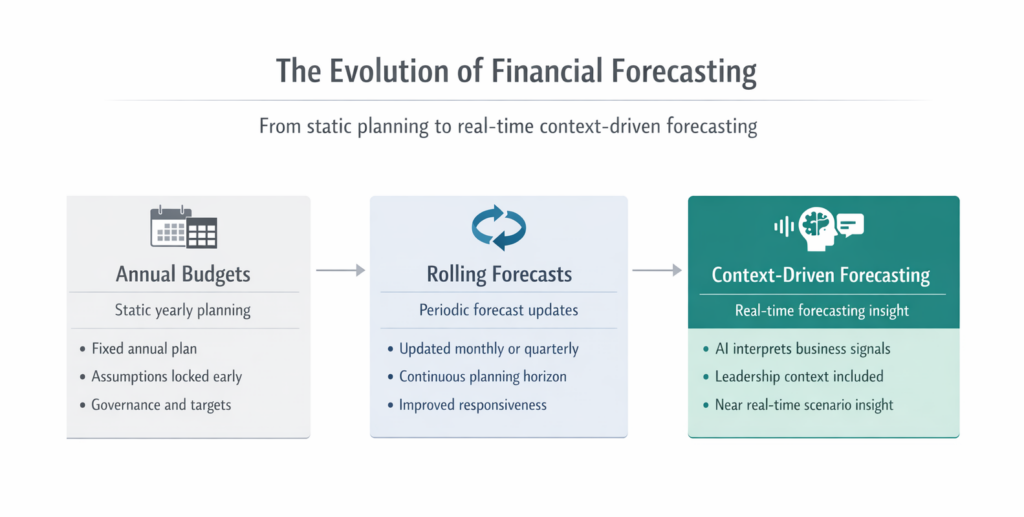
All of our clients have annual budgets, and most have good, largely automated, rolling forecasts. These remain important, but they are not always close enough to the live decision-making conversations within the business. As a result, finance can seem disconnected, and forecasts may not reflect what is actually shaping executive judgment.
Context-Driven Forecasting: Forecasting Aligned With the Business
Context-Driven Forecasting takes a different approach.
Rather than relying solely on periodic forecast updates, it uses AI to interpret broader business context and generate near-real-time forecast insights.
At its core, Context-Driven Forecasting combines three types of information:
- Historical financial time series
- Plain English, qualitative business context
- External market and industry signals
Historical financial data provides the statistical foundation, including trends, seasonality, and cyclical behaviour. But historical numbers rarely capture the full picture. One-offs or anomalies may be present; context, in natual language, helps identify them, allowing for an adjusted baseline that is far more useful for forecasting.
In most businesses, the really important factors that can shape decisions emerge from:
- Executive meeting discussions
- CEO or CFO forward-looking commentary
- Strategic planning conversations
- Operational updates from business leaders
- Emerging industry developments
These factors often reflect what leadership believes may happen next before those expectations are formally embedded into financial models.
Context-Driven Forecasting allows AI systems to analyse these factors, as they are, alongside historical financial trends, producing projections that reflect both numerical evidence and plain Englisgh business context.
The result, when using a standard structure with appropriate guardrails and embedded forecast knowledge, is a near instant forecast with explainable reasoning.
What Annual Budgets, Rolling Forecasts, and Context-Driven Forecasting Each Do Best
These three approaches are most effective when used together.
- Annual budgets provide governance, accountability, and formal targets.
- Rolling forecasts refresh the financial outlook on a structured cadence.
- Context-Driven Forecasting helps finance interpret emerging developments as they arise and bring forecasting more directly into the decision process.
In practice, finance teams often need all three. Budgets support governance. Rolling forecasts support structured planning. Context-Driven Forecasting adds a live, relevant layer, enabling leaders to rapidly assess the impact of changing conditions and clarify their thinking.
Comparing the Three Approaches
| Approach | Role | Frequency | Best Use |
|---|---|---|---|
| Annual Budgets |
Governance and targets |
Annual | Setting accountability, targets, and resource allocation |
| Rolling Forecasts |
Updating financial outlook | Monthly | Refreshing the outlook on a structured cycle |
| Context Driven Forecasting |
Incorporating live context | Real-time | Testing new developments as they emerge |
From Forecasting Process to Earlier Decision Support
One of the most important advantages of Context-Driven Forecasting is that it improves the quality and timing of forecasting discussions.
Traditional forecasting often becomes too focused on process. Finance teams gather inputs, update models, and review outputs, but leadership discussions can remain disconnected from the forecast until after the formal update is complete.
Context-Driven Forecasting changes that dynamic.
It allows finance and business leaders to discuss emerging developments while the forecast is still being shaped, not after the fact. Instead of waiting for the next model refresh, leadership can test how changing conditions may affect the forecast while the discussion is still happening. Because this is done using plain Engligh it becomes much faster and much more accessible.
That leads to better decision support. Finance can respond earlier, challenge assumptions more clearly, and help leadership understand the likely financial impact of changes or potential changes in the business.
In many organisations, this shifts forecasting from a periodic reporting exercise to a more active part of strategic and operational decision-making. It makes forecasting a more active part of decision-making and raises its value in leadership discussions, especially when it accurately reflects executive thinking.
How Context-Driven Forecasting Works
In practice, this means finance can have a tool such as ForesightXL open and active during a forecasting or performance review with the CEO.
If a discussion introduces a new product plan, a sales push, or industry development, those points can be added to the forecast context immediately. Leadership can then test, discuss, and assess the potential impact in the moment.
The business context is updated, and the forecast output is refreshed immediately.
Instead of finance taking notes, returning to the model later, and producing a revised forecast hours or days afterwards, leadership can explore the impact while the discussion is still happening.
That makes forecasting more useful as a decision-support process. It also improves clarity. Assumptions are captured when they are discussed, the potential impact is visible straight away, and the reasoning can be reviewed while the context is still fresh.
Applying Live Context Within a Structured Forecast Framework
Context-Driven Forecasting is only valuable when live business context is applied within a defined forecasting framework.
Without structure, leadership views, commentary, and market developments can influence the forecast in inconsistent, hard-to-trace, and hard-to-govern ways. The value of context is not simply that it is added, but that finance can clearly see how it affects specific parts of the forecast.
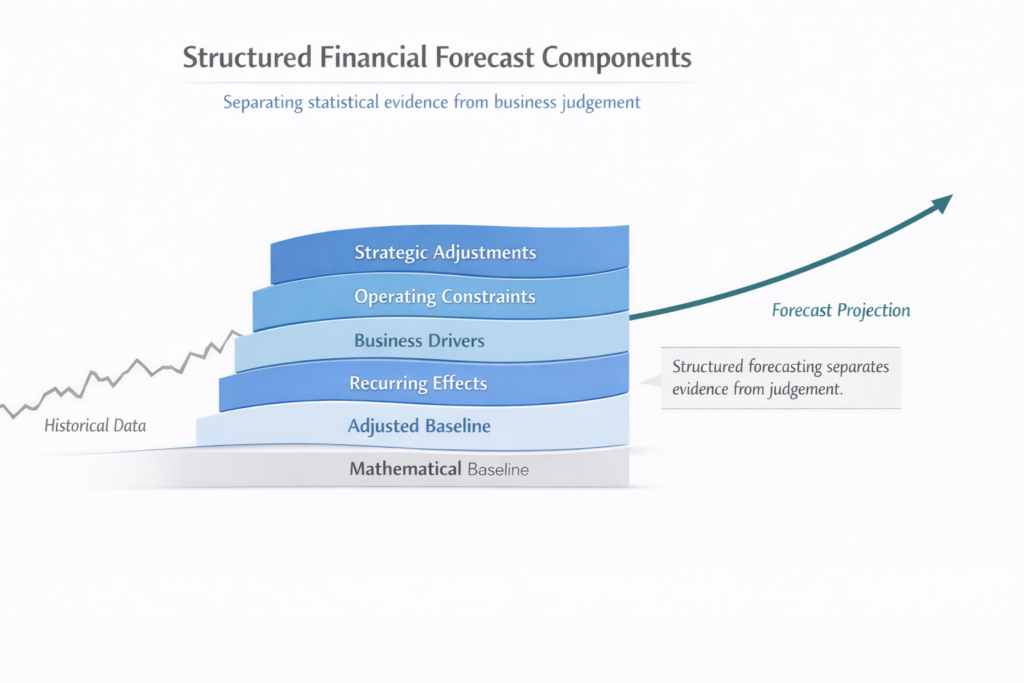
That is why a framework such as the ForesightXL Five Factor Forecasting Framework matters. Rather than treating the forecast as a single moving number, finance teams can assess how new information affects the adjusted baseline, recurring effects, business drivers, operating constraints, and strategic adjustments. This makes forecast changes easier to explain, challenge, and refine.
Used well, context-driven forecasting does not replace traditional forecasting. It strengthens it by helping finance teams respond earlier to change while maintaining transparency, control, and explainability inside Excel.
A Practical Example in Excel
The practical advantage of context-driven forecasting is not simply that it uses AI. It is that AI operates within a structured forecasting process inside Excel, supported by business context, human judgment, and clear guardrails. It fosters conversation and brings forecasting closer to decisions.
In the ForesightXL Five Factor Forecasting Framework worked example, we show how Brydens BI chargeable hours data can be used to separate the adjusted baseline from recurring effects, business drivers, operating constraints, and strategic adjustments. That structure makes it easier to see what comes from historical evidence, what comes from judgment, and which forecast factor each item affects.
The result is a forecast that can be refreshed quickly, reviewed more clearly, and challenged more confidently when leadership wants to test a delayed project, a new sales initiative, or another material change in business conditions.
From Executive Discussion to Forecast Update: An Example
In August, an executive team reviews an Annual Budget prepared eight months earlier alongside the latest Rolling Forecast. The budget assumed revenue growth of 15% by August and 20% for the year, but actual growth to the end of July is just under 6%, with the latest forecast now at 18%.
Since the budget was set, a new product launch was delayed from March to June, reducing its expected December revenue contribution from 10% to 6%, while a new region has outperformed plan, contributing 5% of July revenue versus 3% budgeted.
During the meeting, leadership agrees to accelerate entry into two additional regions from next year into October and approves a temporary doubling of ad spend to build new product momentum. At that point, the existing forecast still contains useful detail, but its core assumptions are already outdated.
Using ForesightXL, those decisions are captured live as structured context. The revenue forecast is refreshed several times during the discussion until a staggered September and November rollout is agreed, with marketing spend tapering into December. The agreed context-driven forecast then becomes the basis for updating the formal rolling forecast over the following days.
The Direction of Modern Forecasting
The finance function is evolving.
CFOs increasingly expect finance teams not only to report on what has happened, but to help the business anticipate what may happen next.
Meeting that expectation requires forecasting processes that are faster, more collaborative, and more closely aligned with the business’s operational reality.
Context-Driven Forecasting supports this shift.
It allows finance teams to combine quantitative analysis with qualitative business insight, identify emerging signals sooner, and participate more actively in strategic discussions.
Annual budgets will remain essential.
Rolling forecasts will continue to provide structured updates.
But as organisations seek to improve forecasting capability, Context-Driven Forecasting offers a valuable additional layer, connecting financial forecasting more directly to the evolving business context.
For modern finance teams, the future of forecasting is not about replacing existing processes. It is about strengthening them with better insight, faster iteration, and deeper collaboration with the business.
Frequently Asked Questions
What is the difference between an annual budget and a rolling forecast?
An annual budget sets formal targets, resource allocations, and accountability for a defined financial year. A rolling forecast updates the expected outlook regularly, often monthly or quarterly, using more recent financial and operational information. In practice, finance teams usually need both: the budget for governance and alignment, and the rolling forecast for a more current view of likely performance.
What is Context-Driven Forecasting?
Context-Driven Forecasting is an approach that combines historical financial time series with broader business context and relevant external signals to generate more responsive forecast insight. It goes beyond periodic model updates by incorporating factors such as executive discussions, operational developments, timing changes, and market movements. The aim is not to replace financial discipline, but to improve the speed at which finance can help the business respond to change.
Does Context-Driven Forecasting replace rolling forecasts?
No. Rolling forecasts remain important for structured planning, governance, and maintaining a formal forward-looking financial view. Context-Driven Forecasting adds another layer by helping finance teams interpret emerging developments between formal forecast cycles and test their likely impact more quickly. Used together, they create a stronger forecasting process that is both disciplined and more closely aligned with real business conditions.
How can AI help with financial forecasting?
AI can help finance teams interpret less-structured inputs, such as leadership commentary, meeting discussions, operational updates, and relevant industry developments, alongside historical financial data. This can improve responsiveness by highlighting emerging signals earlier and helping analysts estimate their potential impact without waiting for the next full forecast rebuild. The real value comes when AI is used within a well-defined forecasting framework that keeps assumptions visible, outputs explainable, and data secure, without requiring system changes or large-scale implementations.
How does ForesightXL fit into this process?
ForesightXL supports a structured forecasting workflow inside Excel by combining historical evidence, business context, and explicit forecast components in a transparent way. It helps finance teams review assumptions, quickly regenerate forecasts, and compare scenarios without rebuilding models from scratch or blending judgment into the baseline. In practical terms, ForesightXL enables Context-Driven Forecasting.