Large superannuation fund
Before3–4 days
AfterUnder 30 minutes
For an allocation exercise, replacing spreadsheet handling with rule-driven allocations and automated journals.
Read the allocation example
Connect your systems, reduce spreadsheet work and make reporting and forecasting easier, with solutions built and supported by people who understand Finance.
30 minutes with Tim Bryden. Free. No obligation.
Trusted by finance teams





For an allocation exercise, replacing spreadsheet handling with rule-driven allocations and automated journals.
Read the allocation exampleFinance, people and valuation data brought together to support linked profit and loss, balance sheet and cash flow forecasts.
See the Acumentis project“Their finance knowledge and willingness to understand our business made the process easy. They just got on with it.”
We start with the sources, rules and reporting your team already relies on.
 Xero
Xero MYOB
MYOB Oracle NetSuite
 Sage Intacct
 Dynamics 365
 TechnologyOne
 Employment Hero
 ELMO
ELMO BambooHR
 Access MicrOpay
 Jobpac
 Cheops
 Procore
 Yardi
Yardi Snowflake
 Databricks
 BigQuery
 SQL Server
 Excel
Excel Salesforce
 HubSpot
 Stripe
Typically within1 monthfrom project kickoff
Know what your solution will deliver.
Bring data and business rules together.
Review and reconcile with your team.
Use your solution with the same team behind you.
We agree scope and timing upfront. Delivery depends on data access and your team's review.
The same team stays with you. Direct support by email, Teams or Slack after go-live.
Tim and Michael bring finance experience to the design, implementation and ongoing support of your solution.
Meet the team
An accountant with an MBA, combining executive and finance leadership with hands-on coding experience.
Tim on LinkedIn ↗
Financial reporting, business intelligence and data integration across government and private organisations. Holds an MBA.
Michael on LinkedIn ↗“CFOs and finance teams work with Brydens BI and stay with us for years because we understand finance and turn conversations into working solutions. Often, they already have a way of doing things, but it’s become too slow, too manual or no longer fits the business. They can talk it through with us, work out a better approach and trust us to build it and support it as their business changes.”
Tim Bryden & Michael VamvakarisBrydens BIBring the finance process that's holding you back. Explore what could improve and where to start.
Leave with a clearer view of your options and a practical next step.
Free. No obligation to engage us. No files or presentation needed.
Tim will reply by email to arrange a time.
We start with your existing systems. The session helps identify what could connect and what needs investigating.
We typically work with established businesses with an internal finance team and complexity across systems, entities or processes. The conversation helps establish fit.
We talk through the bottleneck, explore practical improvements and choose a sensible first step. Any further investigation or implementation is discussed separately, with no obligation to proceed.
For finance teams managing multiple entities, systems and currencies.
Connect your finance systems and automate repeatable consolidation work, so your team can spend more time reviewing the results.
30 minutes with Tim Bryden. Free, with practical next steps.
Your entities use different systems, currencies or account structures.
Finance repeats exports, mappings, reconciliations and adjustments.
You have an internal finance team that needs more time to review the numbers.
Data flows automatically into a finance-certified layer, giving you one consolidated position, with every figure traceable to its source.
See how it works in practice. Tim Bryden walks through a client example.
“The team at Brydens BI brought together data from multiple internal and external sources. Their finance knowledge and willingness to understand our business made the process easy. They just got on with it. Now our financial and non-financial reporting is consolidated and readily available to use. It’s been transformative. The same team that scoped and implemented the solution still supports us today.”
ASX-listed industrial services groupPublished client case study
Standardised imports and shared account mappings replaced spreadsheet-led consolidation. The model now supports 58 entities across the group.
The consolidation step itself takes less than one hour once subsidiaries have closed their books.
Read the full client storyTypically within1 monthfrom project kickoff
We agree the scope and timing upfront. Delivery depends on data access and your team’s review.
We agree the entities, reports and rules your first solution needs.
We connect sources and map accounts into one reporting structure.
Together, we reconcile results and confirm adjustments and controls.
Go live with reporting your team can use, maintain and trace.
The same team stays with you. Direct support by email, Teams or Slack after go-live.
“Finance teams appreciate being able to talk to people who’ve done the work themselves. We understand the pressure of getting the numbers out and have the systems expertise to make that process better. That combination is why teams work with Brydens BI and stay with us—we can talk it through, build what’s needed and keep it working as their business evolves.”
Michael VamvakarisBrydens BISpend 30 minutes with Tim Bryden exploring how to reduce the manual work between your finance systems and your management reports.
In your session, we will discuss:
Afterwards, receive a one-page summary of the reporting bottleneck, opportunities discussed and recommended next step.
Free. No obligation to engage us.
Share your details. Tim will reply by email to arrange a time.
We start with your existing finance systems and reporting process. The strategy session helps identify potential connections and what needs further investigation.
Yes. Multi-entity and multi-currency reporting are common situations we work with. The scope will reflect your ledgers, account structures and consolidation rules.
We typically work with businesses from $40m to $1bn+ in revenue and an internal finance team. Size is a guide: complexity, resources and where we can make a practical difference determine fit.
Bring one process or question you want to improve. You can describe your current systems and approach during the call. You do not need to upload files or prepare a presentation.
We will focus on one challenge, discuss potential improvements and agree a useful next step. If further investigation or implementation would help, we can discuss that separately. There is no obligation to proceed.
For finance teams explaining performance across multiple systems.
Connect reporting to transactions and business context, so your team can investigate movements and review draft commentary with confidence.
30 minutes with Tim Bryden. Free, with practical next steps.
Illustrative example. Draft commentary needs Finance review and supporting source information.
The explanation depends on operational data as well as financial results.
Finance returns to exports and spreadsheets to investigate movements.
Your internal team spends too much time finding detail and assembling explanations.
Drivers, trends and exceptions are surfaced alongside the result, with the ability to drill into the detail and trace movements back to source.
See how it works in practice. Tim Bryden walks through a client example.
“The team at Brydens BI brought together data from multiple internal and external sources. Their finance knowledge and willingness to understand our business made the process easy. They just got on with it. Now our financial and non-financial reporting is consolidated and readily available to use. It’s been transformative. The same team that scoped and implemented the solution still supports us today.”
Australian construction businessPublished client case study
Management can drill into individual deals and view pipeline information alongside budgets and actuals, while the discussion is happening.
Explore the reporting case studyTypically within1 monthfrom project kickoff
We agree the scope and timing upfront. Delivery depends on data access and your team’s review.
We agree the decisions, measures and detail your reporting must support.
We bring financial and operational sources into a shared view.
We test calculations and drill-through against supporting information.
Go live with reporting that helps Finance explain what changed and why.
The same team stays with you. Direct support by email, Teams or Slack after go-live.
“Having worked in finance, we know the questions that come when leadership reviews the numbers. Finance teams work with Brydens BI and stay with us because we build reporting that helps them respond quickly and confidently, with the detail to support their answers. We’re now extending that with AI, combining financial and operational information with the business context they share to help them explore what’s happening and why.”
Tim Bryden & Michael VamvakarisBrydens BIBring one performance question your team struggles to answer. Spend 30 minutes with Tim Bryden exploring what would make the answer easier to find and explain.
In your session, we will discuss:
Afterwards, receive a one-page summary of your analysis question, the information needed and recommended next step.
Free. No obligation to engage us.
Share your details. Tim will reply by email to arrange a time.
Yes. We bring financial and operational information together where it is relevant to reporting, analysis and planning. Available data and connections are assessed during scoping.
No. AI commentary is a draft for your team to review. The supporting data and business context remain essential to evaluating the explanation.
We typically work with businesses from $40m to $1bn+ in revenue and an internal finance team. Size is a guide: complexity, resources and where we can make a practical difference determine fit.
Bring one process or question you want to improve. You can describe your current systems and approach during the call. You do not need to upload files or prepare a presentation.
We will focus on one challenge, discuss potential improvements and agree a useful next step. If further investigation or implementation would help, we can discuss that separately. There is no obligation to proceed.
For finance teams whose critical processes depend on complex workbooks.
Bring important calculations into a controlled, repeatable process while retaining the business rules and flexibility your team needs.
30 minutes with Tim Bryden. Free, with practical next steps.
Allocations, commissions or project forecasts go beyond a standard setup.
Important calculations and adjustments have become difficult to check and maintain.
Your finance team needs clearer ownership, review and continuity.
Critical calculations move into a governed, reviewable environment while Finance retains ownership of the rules, assumptions and outputs.
See how it works in practice. Tim Bryden walks through a client example.
“It was refreshing to work with people who understood Finance as well as the technology. Brydens BI quickly grasped our accounting requirements, found practical ways to automate the work and delivered a solution that fit our business without consuming all our team’s time. We’ve already identified what we want to tackle next, and we’re confident they can deliver it.”
Large superannuation fundPublished client example
Brydens BI replaced manual spreadsheet handling with rule-driven allocations and automated journal generation.
Read the allocation exampleTypically within1 monthfrom project kickoff
We agree the scope and timing upfront. Delivery depends on data access and your team’s review.
We map the inputs, calculations and review steps that matter.
We move agreed logic into a shared, governed environment.
We compare results with the existing process and check exceptions.
Go live with clear ownership and a process your team can maintain.
The same team stays with you. Direct support by email, Teams or Slack after go-live.
“We’ve all worked in finance and built our fair share of sophisticated Excel models, so we appreciate the thinking behind them and the flexibility they provide. We learn from what a team has already built, then use modern tools and database technology to make the process more automatic and reliable while ensuring they still have all the control they need. Where relevant, Excel can even remain part of the solution.
Finance teams value our practical approach and know they can come back to us as their business changes. We understand their finance processes and systems, so they don’t have to spend hours or days bringing us up to speed.”
Tim BrydenBrydens BIBring one finance process that depends on a critical workbook. Spend 30 minutes with Tim Bryden exploring how to improve control without losing the flexibility your team needs.
In your session, we will discuss:
Afterwards, receive a one-page summary of the process discussed, potential control improvements and recommended next step.
Free. No obligation to engage us.
Share your details. Tim will reply by email to arrange a time.
Not necessarily. We assess where Excel remains useful and where critical logic, controls or recurring work would benefit from a more governed process.
Yes. Allocations, commissions and project forecasts are examples of the flexible finance processes we work with. Your rules and requirements define the scope.
We typically work with businesses from $40m to $1bn+ in revenue and an internal finance team. Size is a guide: complexity, resources and where we can make a practical difference determine fit.
Bring one process or question you want to improve. You can describe your current systems and approach during the call. You do not need to upload files or prepare a presentation.
We will focus on one challenge, discuss potential improvements and agree a useful next step. If further investigation or implementation would help, we can discuss that separately. There is no obligation to proceed.
For finance and FP&A teams coordinating plans across the business.
Connect actuals, assumptions and team inputs so forecasts consolidate automatically and scenarios can change without rebuilding spreadsheets.
30 minutes with Tim Bryden. Free, with practical next steps.
Finance collects assumptions from departments, systems and separate templates.
People, projects and other operating drivers need more than a standard setup.
Your internal finance or FP&A team needs a more repeatable way to update the outlook.
Drivers connect directly to the forecast, actuals flow through automatically and Finance can update scenarios without rebuilding the model each time.
See how it works in practice. Tim Bryden walks through a client example.
“We’ve moved from a slow, painful, Excel-heavy annual budget process to a monthly rolling forecast linked directly to our ERP and HR systems. Department heads can review and update their numbers online, and our executives have a dedicated reporting app. By the time we start the annual budget, most of the work is already done.”
AcumentisProperty valuation and advisory
Brydens BI connected these systems through Calumo to support reporting, rolling forecasts and employee-level commission calculations.
See the Acumentis projectTypically within1 monthfrom project kickoff
We agree the scope and timing upfront. Delivery depends on data access and your team’s review.
We define the assumptions, outputs and responsibilities your plan needs.
We link actuals and bring team inputs into one controlled process.
We check calculations and the impact of changes across the forecast.
Go live with a planning process your team can review and update.
The same team stays with you. Direct support by email, Teams or Slack after go-live.
“We’ve seen many teams struggle with budgeting and forecasting. A good process needs to work for the people contributing to it as well as the finance team pulling it together. We understand both the accounting requirements and the practical challenges of getting useful inputs from across the business.
We’ve implemented rolling forecasts and continue to support the teams using them. We connect HR and operational systems and internal data warehouses to planning models that reflect how the business works, helping teams update assumptions, explore scenarios and understand the impact on profit and loss, balance sheet and cash flow. We stay involved as their business changes, helping them keep the process useful and manageable.”
Tim BrydenBrydens BISpend 30 minutes with Tim Bryden exploring how your team could update forecasts with less chasing, consolidation and spreadsheet rebuilding.
In your session, we will discuss:
Afterwards, receive a one-page summary of your planning bottleneck, improvement options and recommended next step.
Free. No obligation to engage us.
Share your details. Tim will reply by email to arrange a time.
The planning process is designed around your team's inputs, rules and review responsibilities. Ownership, permissions and approvals are agreed during scoping.
Yes, where it fits the agreed process. The aim is to reduce uncontrolled templates and manual consolidation while retaining useful ways for Finance to work.
We typically work with businesses from $40m to $1bn+ in revenue and an internal finance team. Size is a guide: complexity, resources and where we can make a practical difference determine fit.
Bring one process or question you want to improve. You can describe your current systems and approach during the call. You do not need to upload files or prepare a presentation.
We will focus on one challenge, discuss potential improvements and agree a useful next step. If further investigation or implementation would help, we can discuss that separately. There is no obligation to proceed.
For finance teams managing acquisitions, new entities and growing complexity.
Connect entities and systems into repeatable reporting and planning processes, helping your team reduce manual workarounds as the business grows.
30 minutes with Tim Bryden. Free, with practical next steps.
Acquisitions and new entities introduce different ledgers and account structures.
New systems, divisions and stakeholders add more recurring requirements.
Finance needs support and automation without rebuilding the model for each change.
A governed model makes it easier to add entities, systems and reporting requirements without rebuilding the finance process every time the business grows.
See how it works in practice. Tim Bryden walks through a client example.
“It was refreshing to work with people who understood Finance as well as the technology. Brydens BI quickly grasped our accounting requirements, found practical ways to automate the work and delivered a solution that fit our business without consuming all our team’s time. We’ve already identified what we want to tackle next, and we’re confident they can deliver it.”
ASX-listed industrial services groupPublished client case study
Most new entities were added by the client’s own team without consulting support, using the established import and mapping process.
New accounts are flagged for mapping through a controlled process.
Read how the model scaledTypically within1 monthfrom project kickoff
We agree the scope and timing upfront. Delivery depends on data access and your team’s review.
We agree the entities, ledgers and group reporting rules.
We bring sources into consistent imports and account mappings.
We reconcile reports and test the agreed consolidation rules.
Go live with a repeatable process and clear ownership of future changes.
The same team stays with you. Direct support by email, Teams or Slack after go-live.
“Some of our clients are highly acquisitive, PE-backed businesses. They value the flexibility of our solutions and how quickly we adapt as new entities, systems and reporting requirements come into the group. We’ve helped teams using multiple ERPs produce consolidated numbers minutes after close, replacing processes that sometimes took weeks.
We work as an extension of their team and have supported some clients through both major people and ERP changes. That’s why CFOs we’ve worked with often make us one of their first calls when they join a new business. They know we’ll understand the challenges, deliver working solutions and stay to support them as the business grows.”
Tim BrydenBrydens BISpend 30 minutes with Tim Bryden exploring where growth is putting pressure on Finance and what to strengthen before the next entity, acquisition or expansion.
In your session, we will discuss:
Afterwards, receive a one-page summary of the growth pressure, finance priorities discussed and recommended next step.
Free. No obligation to engage us.
Share your details. Tim will reply by email to arrange a time.
Different source systems are a common part of the groups we work with. Scoping establishes the connections, mappings and reporting requirements for each entity.
No. We work alongside an internal finance team, adding technical capability and practical advice. Your team's knowledge and involvement remain important.
We typically work with businesses from $40m to $1bn+ in revenue and an internal finance team. Size is a guide: complexity, resources and where we can make a practical difference determine fit.
Bring one process or question you want to improve. You can describe your current systems and approach during the call. You do not need to upload files or prepare a presentation.
We will focus on one challenge, discuss potential improvements and agree a useful next step. If further investigation or implementation would help, we can discuss that separately. There is no obligation to proceed.
For finance teams exploring AI with trusted data and business context.
Connect financial data and business definitions so your team can review draft AI analysis and trace answers back to the supporting information.
30 minutes with Tim Bryden. Free, with practical next steps.
Illustrative example. Draft commentary needs Finance review and supporting source information.
Financial results, operating data and business context sit in different places.
Finance needs traceable information and human review of draft analysis.
You want to explore reporting, investigation or commentary with an internal finance team.
Financial and operational data come together in a governed foundation, giving AI the context it needs to produce useful, traceable outputs for Finance.
AI drafts are for Finance review. Connected data supports checking an answer; it does not guarantee that every output is correct.
See how it works in practice. Tim Bryden walks through a client example.
“It was refreshing to work with people who understood Finance as well as the technology. Brydens BI quickly grasped our accounting requirements, found practical ways to automate the work and delivered a solution that fit our business without consuming all our team’s time. We’ve already identified what we want to tackle next, and we’re confident they can deliver it.”
Mainbrace ConstructionsRetail and industrial construction
The connected environment supports finance and project reporting, estimate benchmarking and cost modelling alongside pipeline prediction.
An example of applied machine learning for project forecasting.
See the Mainbrace projectTypically within1 monthfrom project kickoff
We agree the scope and timing upfront. Delivery depends on data access and your team’s review.
We agree one useful task, its boundaries and how it will be reviewed.
We bring together the sources, definitions and access controls it needs.
We check evidence, permissions and how Finance reviews the results.
Put the agreed workflow into use, with human review and ongoing support.
The same team stays with you. Direct support by email, Teams or Slack after go-live.
“Finance teams value having a sounding board who understands both finance and what AI can practically do. Our work building ForesightXL and developing the ‘finance brain’ concept has given us hands-on experience we can bring to those conversations.
We can quickly turn an idea into something a team can use and test with their own information and business context. That helps finance and the wider business see where AI adds value and whether an approach fits their needs. We stay involved as the technology and their business evolve, helping them build on what works.”
Michael VamvakarisBrydens BISpend 30 minutes with Tim Bryden exploring one useful role for AI in your finance team, and the data, business context and controls it would need.
In your session, we will discuss:
Afterwards, receive a one-page summary of your proposed AI use case, data and control questions, and recommended next step.
Free. No obligation to engage us.
Share your details. Tim will reply by email to arrange a time.
Start with a useful finance question and the information available today. The strategy session can identify data, definition and access gaps that need to be addressed.
Yes. Treat AI analysis and commentary as drafts to evaluate against the supporting information. Traceability supports review; it does not guarantee that every output is correct.
We typically work with businesses from $40m to $1bn+ in revenue and an internal finance team. Size is a guide: complexity, resources and where we can make a practical difference determine fit.
Bring one process or question you want to improve. You can describe your current systems and approach during the call. You do not need to upload files or prepare a presentation.
We will focus on one challenge, discuss potential improvements and agree a useful next step. If further investigation or implementation would help, we can discuss that separately. There is no obligation to proceed.
You work directly with the team doing the work, from the first conversation through implementation and ongoing support.
We deliver a working solution, not a report about potential solutions.
We ask what breaks, what takes too long and what you need to see. You show us the reporting and processes that matter. We use that conversation to establish a practical scope.
You get a straightforward proposal setting out what we will deliver, implementation and recurring costs, and what we need from you. Any additional work and associated costs are agreed before proceeding.
Each phase delivers practical value and gets your team using the system. We build, test, and work with your nominated contact to reconcile, confirm business rules, review outputs, and arrange sign-off.
Email us, call us or message us. You reach people who know your system. Small issues can often be resolved quickly. Larger work gets a clear next step and timeframe.
Everyone in our team has worked in Finance, lived through month-end and posted journals. We understand the pressure of getting the numbers right and being able to explain them.
We combine that experience with reusable integration patterns, documented methods and shared tooling. A recent connection to an unfamiliar system took two days because the consultant could start from a proven approach.That reduces build time and makes the solution easier to support. Shared knowledge, documentation and access mean another team member can pick up the work when needed.
The business details vary, but many of the underlying problems are familiar: connecting systems, mapping accounts, consolidating entities, translating currencies and turning spreadsheets into repeatable processes.
We bring proven methods to those problems, then adapt them to your business. That is what keeps scoping practical and delivery moving.
Show us the reports you rely on, what they tell you and where the process breaks down.
We use those outputs to establish what the solution needs to deliver, then work through the rules, exceptions and controls that make the numbers right. You do not need to explain every formula before we can begin.
It is to preserve the flexibility and business knowledge that made your process valuable in the first place. Shared data, rules, security and controlled processing sit in a governed platform.
Excel remains an option for investigation and modelling, but most users embrace working online, where shared reports, live data and drill-through make it easier to explore results and work together.
The platforms are cloud based. Finance owns its reports, mappings, models and business rules, within agreed controls. We manage the finance solution and its technical changes.
Your IT team is involved mainly in providing credentials to source systems and confirming security requirements. Day-to-day use and ongoing improvements rarely need their involvement.
The lake provides the data. Finance still needs a governed reporting model.
A data lake can give us a strong starting point. Finance still needs mappings, business rules and reconciliations, plus eliminations and currency translation where relevant, along with other finance and business-specific adjustments and an understanding of how the business works, to turn that data into reliable reporting.
Where your existing data platform is suitable, we build on it, working with your IT team on any connections or changes needed. The result is reporting Finance can explain and sign off.
Combine historical data with plain-English business context to produce forecasts your team can review, explain and refine.
Built by Brydens BI. Approved by Microsoft. Available in Microsoft Marketplace.
Use your existing data and workbooks, without moving to a new system.
Add assumptions about pricing, pipeline, costs or market conditions in plain English.
Review a mathematical baseline, AI-assisted adjustments and the reasons behind them.
Support rolling forecasts, reforecasts and what-if analysis.
Plan, report and investigate in one governed workspace.
Finance CoreIQ connects finance data, models and processes, so your team can build reports, manage plans, automate recurring work and find out what is driving the result. AI works from controlled data and approved context. Finance stays in control of the answer.
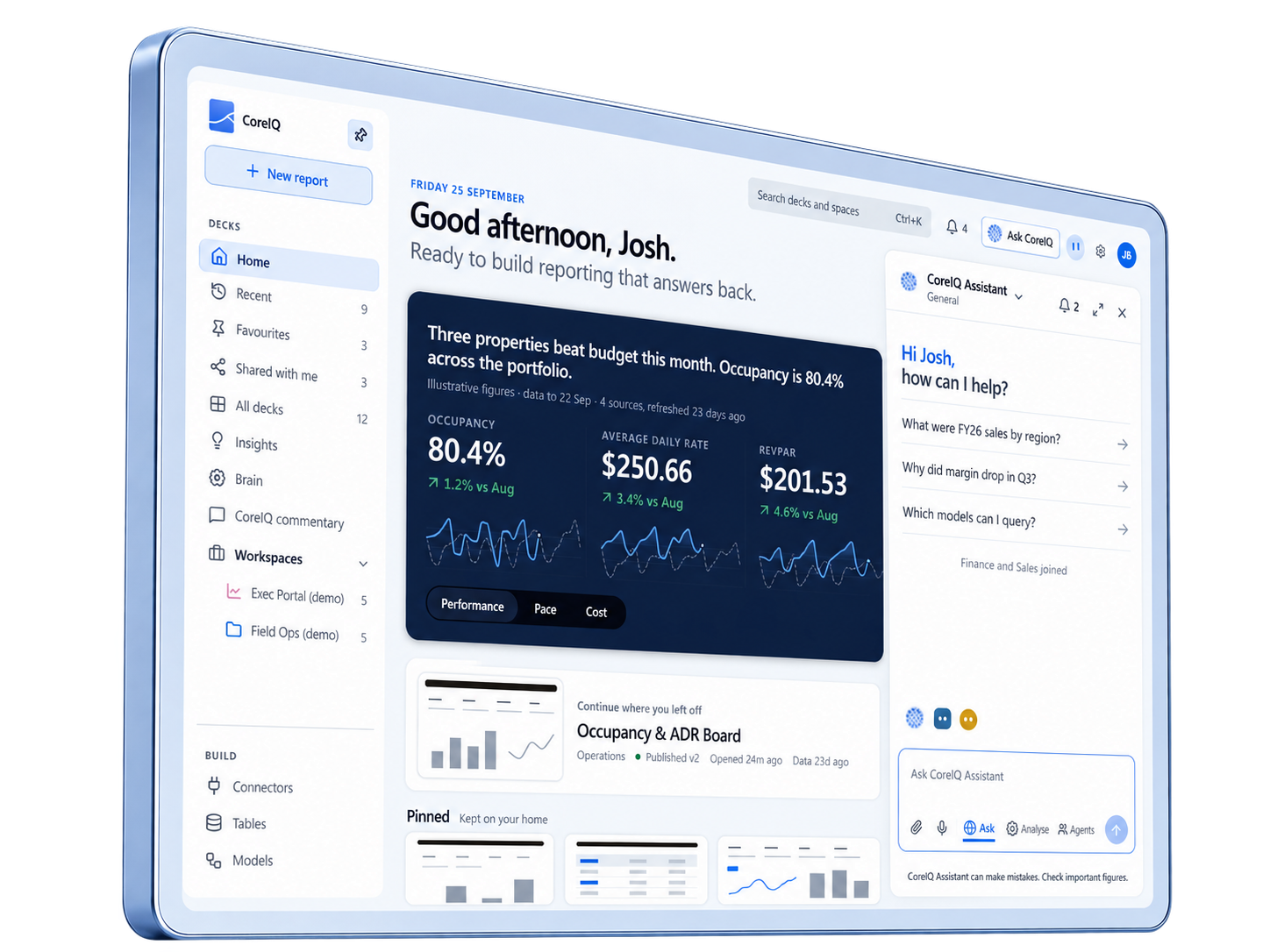
Financial and operational measures on consistent definitions. Shape a view yourself, or let AI draft one for Finance to check before it is published.
Move from a headline result into entities, departments, projects and transactions, without rebuilding the analysis in a spreadsheet.
Actuals, budgets, forecasts and drivers in one connected process, with inputs, approvals and the impact of each assumption visible.
Governed workflows collect inputs, apply business rules and move work through review, including processes that cross Finance and operations.
Finance CoreIQ finds the main drivers of a result and drafts an explanation with supporting figures. Finance checks the evidence and approves the wording.
Reports and work organised in a company workspace, so everyone starts from the same definitions and sees what is relevant to their role.
When Finance asks why a result changed, Finance CoreIQ takes the figures from governed finance data. The Brain then brings in context the user is allowed to see, such as project updates, meeting notes and reporting definitions.
Knowledge is organised for the whole company, a workspace or an individual. Finance reviews the evidence and stays responsible for the final answer.
Once the data refreshes, Finance CoreIQ investigates the variances across the pack and drafts commentary from the supporting detail and prior months.
Finance starts the review with explanations already drafted, potentially minutes after refresh, and spends its time challenging findings and signing off.
Finance CoreIQ works next to an established finance environment. For Calumo clients, a first use case can draw on a controlled copy of trusted actual and plan data while Calumo remains the authoritative source.
Bring a reporting question, a planning process or an operational problem Finance is helping to solve. We will walk through how Finance CoreIQ could help, what it would need and how it would sit alongside your current systems.
Contact us today to discuss a clearer path forward.
Not ready to talk? See what month-end costs you now
Governed consolidation, reporting and planning on Calumo.
We replace spreadsheet-heavy consolidation, reporting and planning with Calumo solutions built on Microsoft Azure. Better control, less manual effort, and a foundation that scales with the business.
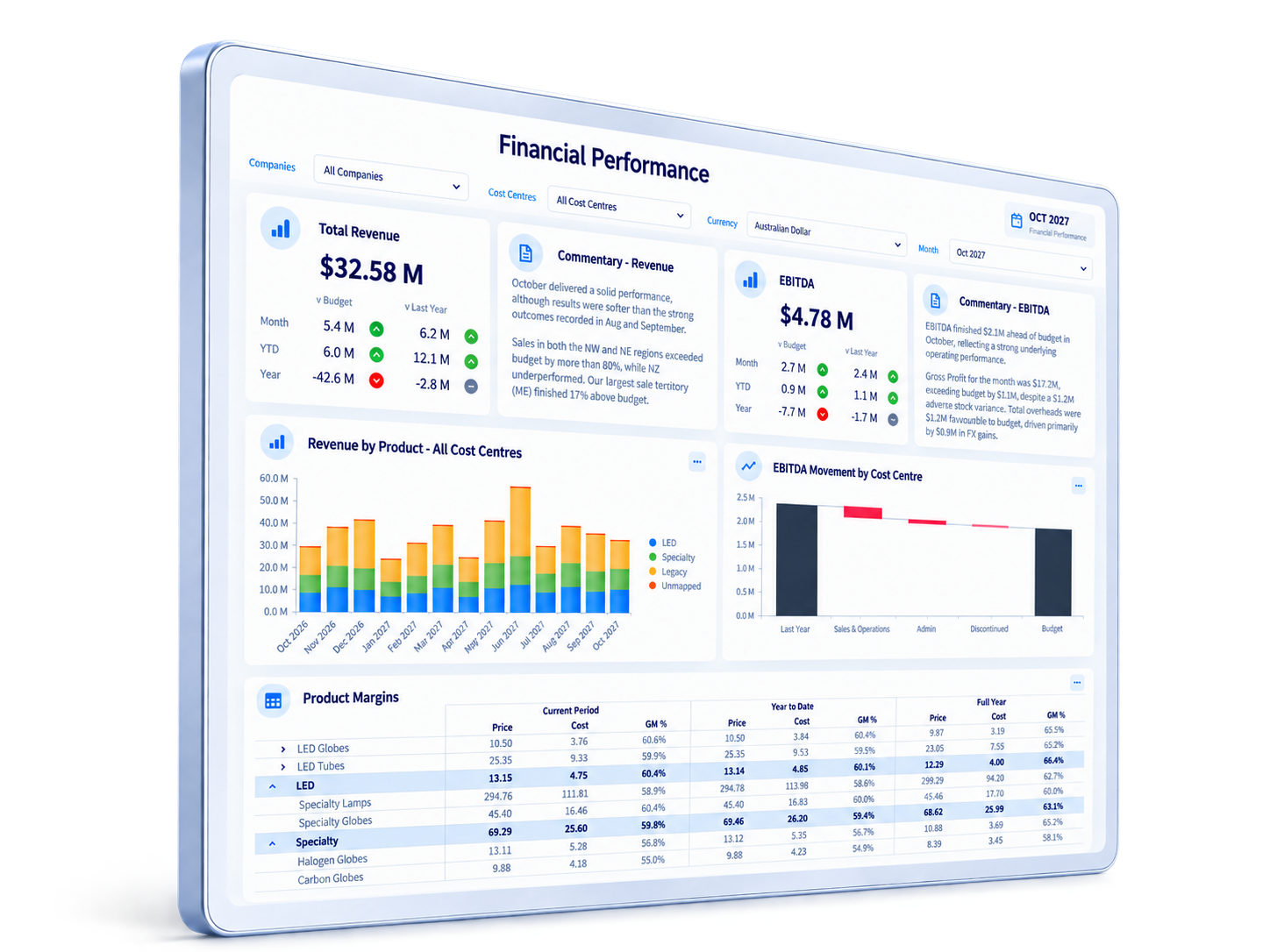
Automated eliminations and multi-currency consolidation, board-ready packs, and drill-through from summary to transaction.
Driver-based rolling forecasts, scenario modelling and workflow governance, aligned to actuals.
One source of truth across ERP, GL, payroll, CRM, HR and operational data, on a governed Azure model.
Structured support, performance tuning, enhancements and training as reporting needs change.
An ASX-listed industrial services group moved from spreadsheet-led consolidation across six GL systems to a Calumo model that has since absorbed 27 more entities.
APIs and Azure Data Factory where cloud endpoints exist, direct database connections where those are better. Source data becomes finance-ready, and Finance can enrich it and write planning inputs back.
No. Excel stays part of how Finance works. It just stops being the uncontrolled source of truth: governance, control and scale move into the model.
Whether you are planning a new Calumo implementation or want more from the one you have, we will review how your consolidation, reporting and planning run today and where the effort is going.
Contact us today to discuss a clearer path forward.
Not ready to talk? See what month-end costs you now
Short videos covering the features finance teams use most: navigating the member explorer, controlling dropdowns, keeping reports dynamic, charting, and live linking into Word and PowerPoint.
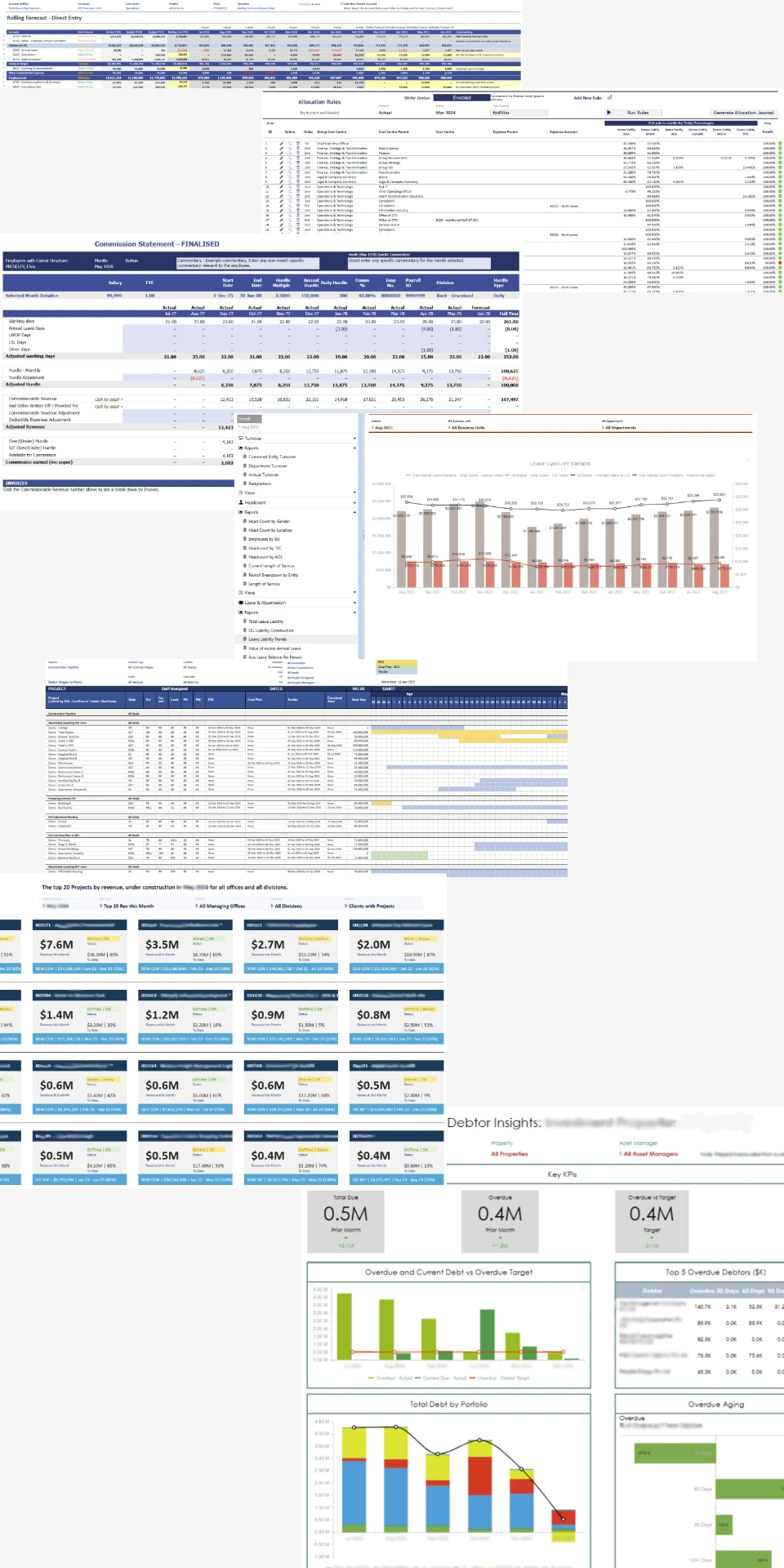
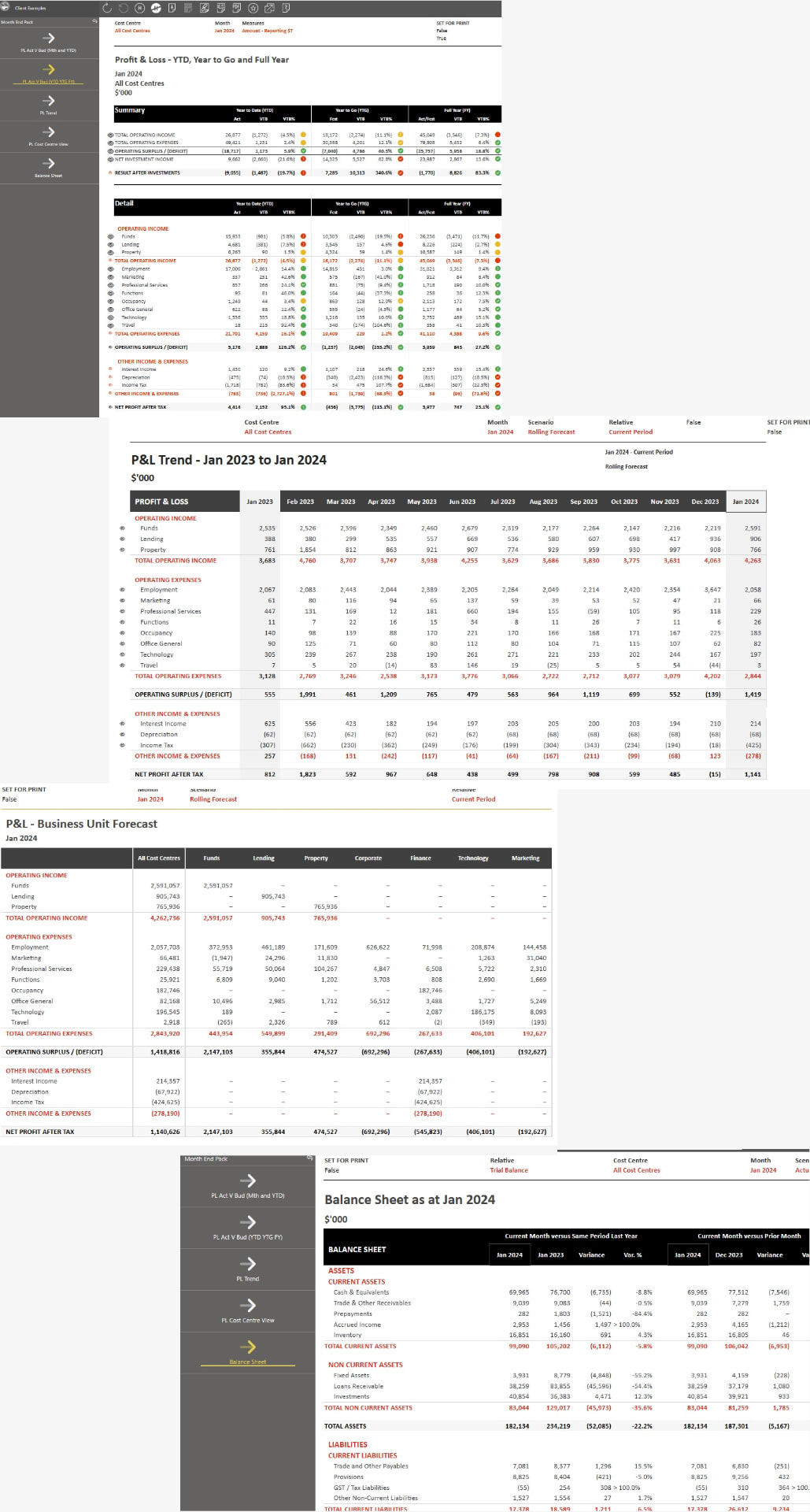
← Back to CalumoCalumo is a flexible tool with many reporting and interface possibilities. Reports can be fully dynamic, linked to each other with context awareness, include data from multiple sources, allow writeback of numbers, allow rich text commentary (that will appear in all relevant related places), include tooltips, drill to detail and lots more. And, of course, they can be formatted in every way imaginable.
Below is a mix of different Calumo report examples. To learn more, contact Brydens BI and ask for a demo.
Enterprise performance management, implemented end to end.
We implement, optimise and support JustPerform, the enterprise performance management platform from insightsoftware. Enterprise-grade capability, with an experience finance teams can own.
Fine-grained permissions, audit trails and workflow-driven processes that reduce spreadsheet risk and improve accountability.
Suited to complex consolidation and planning, including multi-entity structures and enterprise-scale performance needs.
An Excel-familiar experience lets Finance run planning and close, while IT keeps governance and security.
We implement and support more than one EPM platform, so selection stays grounded in your outcomes, governance needs and total cost of ownership rather than a product we need to sell.
Whether you are exploring JustPerform or modernising your finance systems, we will look at what you run today and what a practical EPM roadmap would look like.
Contact us today to discuss a clearer path forward.
Not ready to talk? See what month-end costs you now
Whether it’s reporting that takes too long, spreadsheets carrying too much risk, disconnected systems, a forecast that’s always out of date, or a process that no longer scales, we’ll help you find a clearer way forward.
Contact us today to discuss a clearer path forward.
Not ready to talk? See what month-end costs you now
Choose a time for 30 minutes with Tim Bryden on Teams.
Focus on one finance process, performance question or decision. Discuss potential improvements and agree a practical next step.
Leave the session with a clearer view of the options and a practical next step.
Free. No obligation to engage us. No need to upload files or prepare a presentation.
Manual close processes rarely look expensive because the cost is spread across people, systems and repeated work. But once you add up the hours spent reconciling, consolidating, checking and rebuilding reports every month, the number can be significant.
Use the calculator to estimate the annual cost of your current finance process, and compare that with what a more automated, scalable approach could look like.
The calculator shows the cost of the current process. We can help you work out where that time is being lost, what can realistically be automated, and what a better finance process could look like for your business.
Contact us today to discuss a clearer path forward.
Brydens BI prides itself on long-term client relationships and on developing deep knowledge of clients’ businesses. We design, build and continually evolve bespoke solutions in partnership with key client staff.
We connect finance and operational data to support consolidation, planning, dashboards and reporting, with automation for processes such as eliminations, allocations and adjustments. Each solution is tailored to the client’s business, designed, implemented and actively supported by Brydens BI as their needs evolve.
Beyond standard reporting and planning, our solutions are flexible enough to address your specific challenges, from a custom calculation or workflow to a purpose-built app for your team, clients or employees.
Our team has extensive finance backgrounds. That is what makes same-day turnaround possible for most questions and support requests. Send a Slack, email or Teams message directly, and we respond.
{{ c.body }}
{{ c.built }}
{{ otherClients }}
Brydens BI prides itself on long-term client relationships and on developing deep knowledge of clients’ businesses, in many cases becoming extensions of the finance team. We design, build, and continually evolve bespoke solutions in partnership with key client staff.
Clients are both private and public, and are based across the globe with a mix of Australian, Asian, North American, and European operations.
We connect finance and operational data to support consolidation, planning, dashboards and reporting, with automation for processes such as eliminations, allocations and adjustments. Brydens BI designs, implements and actively manages these solutions for reliability, scalability and ongoing improvement.
Our team has extensive finance backgrounds. This helps with same-day turnaround for most questions and support requests.
Our clients often share some of these characteristics. Revenue and size are useful guides, but the strongest fit comes down to the complexity of your business and where we can make a practical difference.
Big enough for the complexity to be real, small enough that finance still feels every manual step.
Acquisitions, different ledgers or varied account structures have made consolidation a bottleneck and a source of risk. We make it controlled, repeatable and automated.
Ideally with FP&A. We extend a team; we do not replace one.
Comfortable using Microsoft technology and exploring practical AI where it adds value.
New entities, systems and reporting demands have added spreadsheets, manual steps and workarounds.
Finance needs reporting, analysis and planning that bring together multiple systems and reflect how the business works.
Allocations, commissions, project forecasts or other business processes need more than a standard setup.
The team sees the need for change and has someone ready to help lead it.
An extension of your finance team, bringing technical capability and practical advice when you need it.
We support reporting and planning using retail data. Implementing point-of-sale systems and processing sales transactions sit outside our focus.
We connect manufacturing and inventory data into reporting and planning. Configuring production, standard costing, WIP and inventory valuation systems requires specialist expertise outside our focus.
We focus on management reporting, analysis and planning, including daily and weekly reporting where appropriate. Systems that monitor and respond to operational events in real time sit outside our focus.
Not because it cannot be done. Because we specialise, and in some areas we have much more experience than others.
Whether it’s reporting that takes too long, spreadsheets carrying too much risk, disconnected systems, a forecast that’s always out of date, or a process that no longer scales, we’ll help you find a clearer way forward.
Contact us today to discuss a clearer path forward.
Not ready to talk? See what month-end costs you now
Brydens BI designs, implements, manages and supports reporting, consolidation, budgeting, forecasting and finance automation for mid-market and enterprise groups. Our team combines deep finance experience with modern data capability, and many of our clients have worked with us for years.
When CALUMO was sold to insightsoftware, Tim chose not to join a large US software business. He called about a dozen clients to say what he was doing. Ten of them moved across on the same day. Brydens BI was busy from the first morning. The eleventh moved a month later.
That is still how we work. Long relationships, a deep understanding of each client's business, and solutions we design, build and keep improving alongside the finance and leadership teams.
Our work is grounded in finance expertise and extends to operations and the broader business. We understand how financial and operational information come together to explain performance and support better decisions.
The people who scope your solution build it and support it. They carry their understanding of your business through every stage, from the first conversation to ongoing improvements.
Contact the people who know your business by Slack, Teams or email. Many responses are within minutes, with others usually within the same hour or day. Support is a conversation, not a queue.
We’re open about what we can deliver, where we can add value and whether we’re the right people to help. We’ll tell you if a different approach would serve you better.
We start with how your business works, the challenges you face and the decisions you need to make. Then we shape the solution around those needs, connecting Finance with the wider business.
We break delivery into manageable steps, get useful improvements into your team’s hands early and build from there. Your team’s experience helps shape what comes next.
Reliable reporting starts with agreed definitions, consistent rules and figures you can trace to their source. We build that foundation into your solution, giving your team numbers they can trust and AI the reliable data and business context it needs to deliver real value.
We use AI in our own work, test its limits and learn where it delivers real value. That experience helps us apply it to your business, with a clear view of what works, what needs checking and where human judgement matters.
We stay involved as your business evolves, helping your reporting, planning and processes keep pace. For some clients, we become an extension of their internal teams, bringing finance expertise, technical capability and practical advice when needed.
Twenty years of building solutions for diverse finance teams and businesses have given us proven patterns, consolidation rules, allocation methods, report structures and integration methods across 25 ERPs and dozens of other systems. We adapt that experience to your business, giving our consultants a practical starting point. Years of partnering with clients have taught us what good looks like and what works in practice.
How we workWe implement and support Calumo and Finance CoreIQ for reporting, analysis, budgeting and forecasting.
These platforms connect financial and operational data through a governed data foundation on Microsoft Azure, with access through web applications, Excel and Power BI.
An accountant with an MBA, Tim combines executive and finance leadership with hands-on coding experience across listed and large private organisations. Specialises in understanding how businesses work, making sense of complex situations and translating that understanding into practical solutions.
LinkedInFinancial reporting, business intelligence and data integration across government and private organisations, including leading Business Reporting in a NSW State Government department. Specialises in enterprise reporting platforms, APIs, system integrations and ESG reporting. Holds an MBA.
LinkedInWe implement and support Calumo and Finance CoreIQ, connecting financial and operational data through a governed data foundation on Microsoft Azure. Online, Excel and Power BI give your team familiar ways to report, analyse and plan.
Source systems
Governed data foundation
Reporting, planning & AI
Business outputs
Designed, implemented and supported by Brydens BI. Built around your business.
The platform is the starting point. The value comes from connecting your data, defining the rules and building the reports, calculations and workflows your business needs. We design, build and support that solution, drawing on years of practical business and systems experience.
Whether it’s reporting that takes too long, spreadsheets carrying too much risk, disconnected systems, a forecast that’s always out of date, or a process that no longer scales, we’ll help you find a clearer way forward.
Contact us today to discuss a clearer path forward.
Not ready to talk? See what month-end costs you now
Articles on reporting, consolidation, FP&A, forecasting, finance data and automation, from the team that builds these systems every day.